

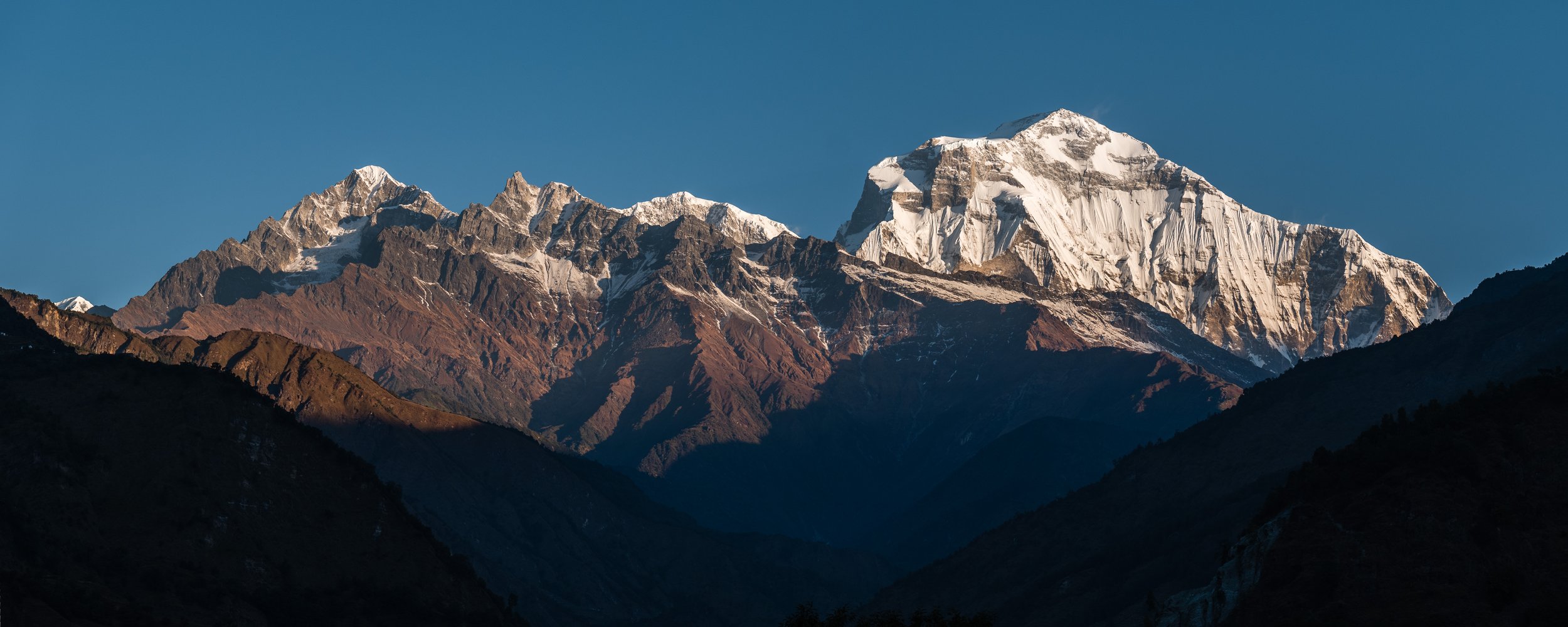
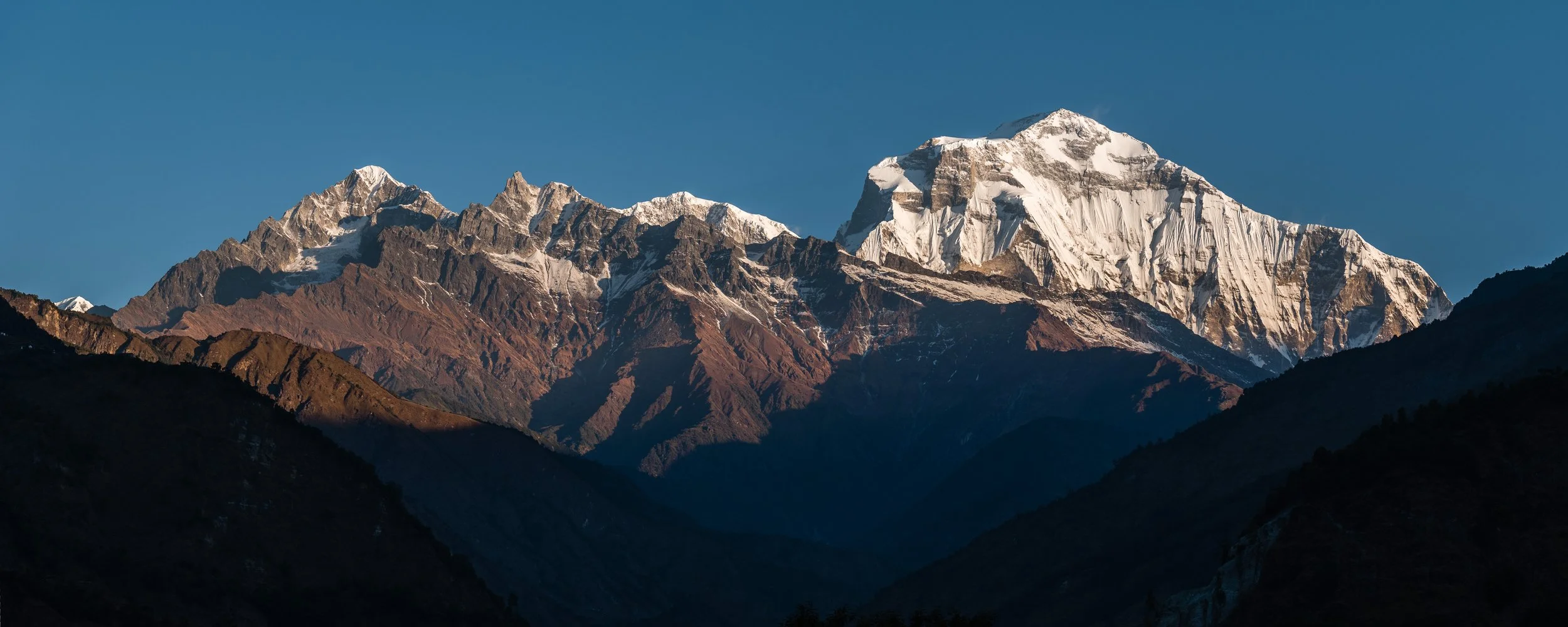
DHAULAGIRI 8167m - Summit the world’s 7th highest mountain
Highlights
Dhaulagiri, 8167M Summit
North East ridge, route. Camp 1 - 3 strategy
1:1 Guide/Client ratio (additional support on team size) Small team strategy. 1-8 max client members.
16 Weeks of training programs for 8000M fromTraining Peaks
30 - 33 Expedition program
Helicopter 🚁 In/Out (Signature program)
Overview
Dhaulagiri 8167m is considered the seventh highest peak in the world. Renowned for its massive vertical rise above the local terrain and its notorious weather patterns. Unlike some of its 8,000m peers, Dhaulagiri demands respect through technical ridges and high-wind exposure. The climb via the Northeast Ridge involves navigating steep ice and snow slopes, requiring climbers to be proficient in technical cramponing and fixed-line transitions.
At NAMAS, we offer three distinct climbing programs, each designed to match different experience levels, support preferences, and expedition goals.
Pre-requisite experiences (at least one 6000M & 7000M or 8000M+): Lobuche East & Island Peak,Annapurna 5X Summit challenge, Khumbu 3 Peak expeditions, Tilicho peak, Annapurna IV, Ama Dablam, Manaslu . Multi-pitch climb (rock or ice), rock climbing grade up to 6B to 7B+, Mixed climbing M6-7 grade.
Is Dhaulagiri Right For You?
Dhaulagiri is a serious undertaking and is not recommended as your first 8,000m peak. Due to its technical nature and sustained exposure, we require our climbers to have a proven high-altitude resume.
To ensure you are physically and mentally prepared for the "White Mountain," we highly recommend completing at least one entry-level 8,000m peak—such as Manaslu or Cho Oyu—or several technical 6,000m to 7,000m peaks (like Ama Dablam or Annapurna IV) before joining this expedition.
For those looking to maximize their season in the Himalayas, Dhaulagiri can be tackled as a standalone objective or strategically paired with other giants like Makalu or Everest for climbers with advanced acclimatization and experience.
The Best Time to Climb
At Namas Adventure, we prioritize the Spring climbing season (April–May) for Dhaulagiri.
Stable Weather: Historically, Spring offers the most reliable weather windows and more predictable snow conditions on the Northeast Ridge.
Success Rates: The vast majority of successful summits are recorded in the Spring.
The Autumn Risk: While possible, the Autumn season in this region of Nepal is notorious for unpredictable weather patterns and higher wind speeds, which can significantly impact safety and summit success.
-
USD 37,000 Per person - Signature climb
USD 33,000 Per person - Classic+ PLUS climb
USD 29,000 Per person - Classic climb
Deposit: USD $5,000
All-inclusive. Guaranteed departure. No extra hidden costs.
Please inquire about prices in your local currency. We accept payment in £GBP/ €EUROS/ $AUD
-
2027
27th March - 25th April - Signature climb
-
IFMGA or NNMGA certified Guide 1:1 ratio
Namas Branded merchandise (Down Jacket, Cap, Buff)
16 Weeks of training programs for 8000M from Training Peaks
Head chef and kitchen helpers (Helpers increase with the number in climbing team members)
2 nights before the expedition and 1 day after the expedition. 5 Hotel in Kathmandu. Single room. (Should clients return early from their expedition, clients will be responsible for their extra Kathmandu hotel bookings)
2 Nights luxury stay in Nagarkot. 90 min Massage session, breath-work session, foot massage reflexology & facial, after expedition. (Sauna included)
All trekking and climbing permits (Permit and TIMS)
Expedition tents (2 tents) Brands Salewa, Mountain Hardwear, Samaya equipment, Kailas
4 Oxygen Bottles
60 kgs personal weight
🚁 Helicopter Pokhara - Yak Kharka and back to Kathmandu after the expedition
Chocolate, energy bars, hydration pills, biscuits, canned foods, nuts
Burners and expedition equipments
Walkie-talkie/ Satellite phone
Breakfast, Lunch, and Dinner on trek and expedition days.
Lodge accommodation during the trek
Porters per guest
Arrival pick-up and departure
Basic First aid kit
Welcome/Farewell leave Dinner
-
NNMGA certified Guide leader 1:1 ratio
Namas Branded merchandise (Down Jacket, Cap, Buff)
16 Weeks of training programs for 8000M fromTraining Peaks
Head chef and kitchen helpers (Helpers increase with the number in climbing team members)
2 nights before the expedition and 1 day after the expedition. 5 Hotel in Kathmandu. Single
room. (Should clients return early from their expedition, clients will be responsible for their extra Kathmandu hotel bookings)
90 Min massage session after the expedition (Kathmandu)
All trekking and climbing permits (Manaslu Region Permit and TIMS)
Expedition tents (2 tents) Brands Salewa, Mountain Hardwear, Samaya equipment, Kailas
3 Oxygen Bottles
60 kgs personal weight
Drive/trek to BC and back to Pokhara or Kathmandu after the expedition via helicopter 🚁 &✈
Chocolate, energy bars, hydration pills, biscuits, canned foods, nuts
Burners and expedition equipments
Walkie-talkie/ Satellite phone
Breakfast, Lunch, and Dinner on trek and expedition days.
Lodge accommodation during the trek
Porters per guest
Arrival pick-up and departure
Basic First aid kit
Welcome/Farewell leave Dinner
-
NNMGA certified Guide leader
Nama branded merchandise (Down Jacket, Cap, Buff)
1:1 Sherpa/client ratio. (Additional Sherpa can be arranged, extra charges apply)
16 Weeks of training programs for 8000M fromTraining Peaks
Head chef and kitchen helpers (Helpers increase with the number in climbing team members)
Arrival hotel. Single room - 4 Star Kathmandu and 5 * Pokhara
All trekking and climbing permits (Permit and TIMS)
All internal-local transportation to and from the trekking trailhead
Expedition tents, single tents in Base Camps and shared in higher camps Brands Salewa, Mountain Hardwear, Samaya equipment, Kailas
3 Oxygen Bottles
60 kgs personal weight
Chocolate, energy bars, biscuits, canned foods, nuts
Burners and expedition equipments
Walkie-talkie/ Satellite phone
Breakfast, Lunch and Dinner on trek and expedition days
Lodge accommodation during the trek
Porters per guest
Arrival pick-up and departure
Basic First aid kit
Welcome/Farewell leave Dinner
-
Visas and travel insurance
Bonuses ($1500 Summit, $500 Camp 1 and 2, $1000 Camp 3 & 4)
Entertainment and food (Kathmandu and Pokhara)
Bottled drinks and beverages
Evacuation (will be done in your account)
Tips (Service Charge in Hotel and Restaurants are included)
Single supplement Charges
Laundry, Phone services, Personal expenditure transactions
Optional trips
Tea breaks, chocolates or other snacks and any meals besides breakfast, lunch and dinner
Delay and cancellation because of natural phenomenon
International flights to Kathmandu
Itinerary - Signature Climb
Day 1 Arrival, Airport pick up by Namas members
Day 2 Briefing, gear check and final gear and dinner
Day 3 ✈ Fly to Pokhara and 🚁 shared fly to Yak Kharka 3680m
Day 4 Acclimatisation day
Day 5 Yak Kharka to Dhampus BC via Thapa la pass 5666m
Day 6 Dhaulagiri bc 4750m
Day 7 - 26 Climbing period
Day 27 🚁 -28 Shared heli back to Pokhara or ✈ Kathmandu. Nagarkot - NAMAS Signature
Reset & Recover
Day 29 Kathmandu
Day 30 Departure
-
Day 1 Arrival, Airport pick up by Namas members
Day 2 Briefing, gear check and final gear and dinner
Day 3 Fly to Pokhara and hotel
Day 4 Drive to Marpha, 2650m
Day 5 Trek to Yak Kharka 3680m
Day 6 Acclimatisation day
Day 7 Yak Kharka to Dhampus BC via Thapa la pass 5666m
Day 8 Dhaulagiri bc 4750m
Day 9 - 28 Climbing period
Day 29 🚁 Shared heli back to Pokhara or ✈ Kathmandu
Day 30 Departure
-
Day 1 Arrival, Airport pick up by Namas members
Day 2 Briefing, gear check and final gear and dinner
Day 3 Fly to Pokhara and hotel
Day 4 Drive to Marpha, 2650m
Day 5 Trek to Yak Kharka 3680m
Day 6 Acclimatisation day
Day 7 Yak Kharka to Dhampus BC via Thapa la pass 5666m
Day 8 Dhaulagiri bc 4750m
Day 9 - 28 Climbing period
Day 29 Back to Yak Kharka
Day 30 Drive to Marpha
Day 31 Marpha to Pokhara
Day 32 Fly to Kathmandu
Day 33 Departure
-
Day 27 — Physical Reset & Nervous-System Downshift
Arrival - Silent check-in & welcome ritual (no briefings, no schedules)
Deep tissue / sports recovery massage (60–90 mins) - Focus: calves, quads, hips, lower back, shoulders
Infrared or traditional sauna session
Guided breath work session (20–30 mins) - Helps shift from survival mode to recovery mode
Day 28 — Mental Closure & Gentle Reawakening
Slow wake-up with sunrise Himalayan views
Guided mindfulness or reflection session → closing the climb mentally, not just physically
Foot therapy / reflexology and Facial
Guided breath-work session (20–30 mins) - Helps shift from survival mode to recovery mode
-
680 Summits
-
Everest 8848m - Please inquire
Makalu 8485m - Please inquire
Lhotse 8516m - Please inquire
Guiding team
Our guiding team brings extensive experience from leading expeditions on Dhaulagiri, Everest, Annapurna I, Manaslu, K2, Gasherbrum, Baruntse, Ama Dablam, and numerous other major peaks in Nepal and internationally.
Our guides are certified team professionals who are trained and assessed through the International Federation of Mountain Guides Associations (IFMGA) and the Nepal Mountaineering Association (NNMGA). Highly skilled and competent team members along with guiding effectively their role are to provide a dedicated level of security to you during the expedition. Our guide's contribution is predominantly around making decisions to keep you safe and healthy and to avoid mishaps. Their experience is based solely on years of first-hand experience on the mountain and leading several expeditions with Namas teams. Our team consists of both international and local members, where we know the knowledge and understanding both the worlds brings in a lot of value when working together, implement effective strategies and plan back-up contingency plans in case of setbacks during our expedition. These are world-class climbers and guides who are knowledgeable, kind, strong, experienced, respectful, and very proficient. We provide a 1:1 Sherpa/Guide ratio resulting in more support and backup for your summit attempt and therefore a greater safety margin and the chance of success.
-
Northeast Ridge
Advanced Base Camp (ABC): ~5,300m – 5,850m
Camp I: ~5,900m – 6,100m
Camp II: ~6,400m – 6,600m
Camp III or IV (Final Camp): ~7,200m – 7,500m
Summit: 8167m
-
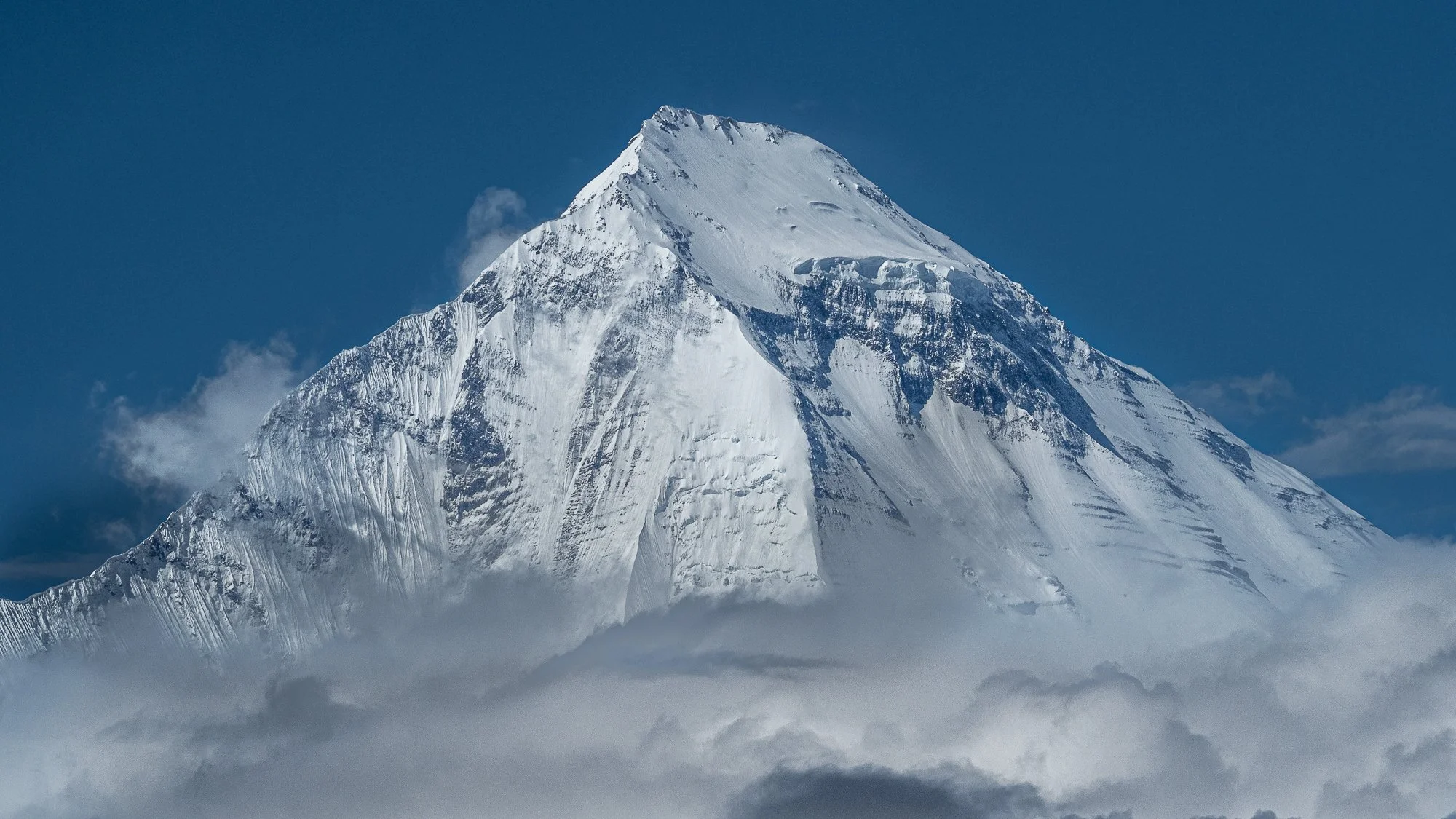
Dhaulagiri is derived from the Sanskrit words dhawala (dazzling, white, beautiful) and giri (mountain), translating to "White Mountain" or “Dazzling Mountain”
-
Dhaulagiri I (8,167 m) was first summited on May 13, 1960 by a Swiss-Austrian-Nepali team via the Northeast Ridge. Led by Max Eiselin, the successful team included Kurt Diemberger, Peter Diener, Ernst Forrer, Albin Schelbert, and Sherpas Nawang Dorje and Nima Dorje, who achieved the feat without supplementary oxygen
HOW DOES IT WORK?
1. Initial Inquiry and Planning
At NAMAS Adventure, we start by understanding your aspirations and goals. From your first conversation with our expert team, we provide personalized recommendation tailored to your interests. Once the perfect expedition is identified, a deposit secures your spot. We then work closely with you to plan and prepare every detail—from gear selection and training advice to arranging insurance, permits, and logistics.
2. Preparing for the Journey
As your expedition date approaches, we’ll help you finalize all preparations. This includes collecting the final balance payment (typically due 60-90 days before your trip), ensuring all necessary documents are in order, and addressing any remaining questions. Our team is available via email or phone calls to make sure you’re fully prepared and confident for the adventure ahead.
3. On-Expedition Support
Arrive at your destination ready to begin! From pre-expedition briefings and gear checks to the full support of our experienced guides and ground team during your climb, we’re here to ensure everything runs smoothly. With flexibility to adapt to any changes or needs, we’re committed to making your adventure seamless, enjoyable, and unforgettable

Frequently Asked Questions
-
At Namas Adventure, we prioritize the Spring climbing season (April–May) for Dhaulagiri.
Stable Weather: Historically, Spring offers the most reliable weather windows and more predictable snow conditions on the Northeast Ridge.
Success Rates: The vast majority of successful summits are recorded in the Spring.
The Autumn Risk: While possible, the Autumn season in this region of Nepal is notorious for unpredictable weather patterns and higher wind speeds, which can significantly impact safety and summit success.
-
Dhaulagiri I (8,167m) is widely considered one of the more technical and demanding 8,000m peaks, sitting a significant step above "entry-level" giants like Manaslu or Cho Oyu. On the global mountaineering scale, it is typically rated as Very Difficult.
1. Technical Complexity
Unlike the straightforward snow slopes found on some other 8,000m peaks, Dhaulagiri’s Northeast Ridge involves sustained technical climbing.
Terrain: You will encounter steep ice and snow slopes ranging from 35° to 50°.
Skills Required: Proficiency in technical cramponing, ice axe arrest, and efficient fixed-line transitions is mandatory. Sections like the traverse to the true summit are highly exposed and require steady nerves.
2. Physical Endurance
The "White Mountain" is notorious for its massive vertical rise.
Vertical Gain: Some days involve climbing over 1,000 meters of vertical elevation between camps (specifically Camp 2 to Camp 3), which is an exhausting feat at such extreme altitude.
The Summit Push: The final push from Camp 3 to the summit is long and involves navigating a "False Summit" before reaching the true highest point, demanding deep physical and mental reserves.
3. Objective Hazards
Dhaulagiri is famous—and at times feared—for its notorious weather patterns.
High Winds: Its position makes it a lightning rod for high-altitude winds, which can be significantly stronger here than on neighboring peaks.
Avalanche Risk: Certain sections, particularly between Base Camp and Camp 1, are prone to avalanche activity, requiring expert timing and route management
-
Crevasses between bc - 1 and 2
Avalanches prone zone between base camp to camp 1
-
We do not chase a summit on bad infrastructure. In Spring 2025, NAMAS turned back at 8,040m after assessing that the final section relied on outdated fixed lines/anchors—a deliberate “survival over summit” decision.
-
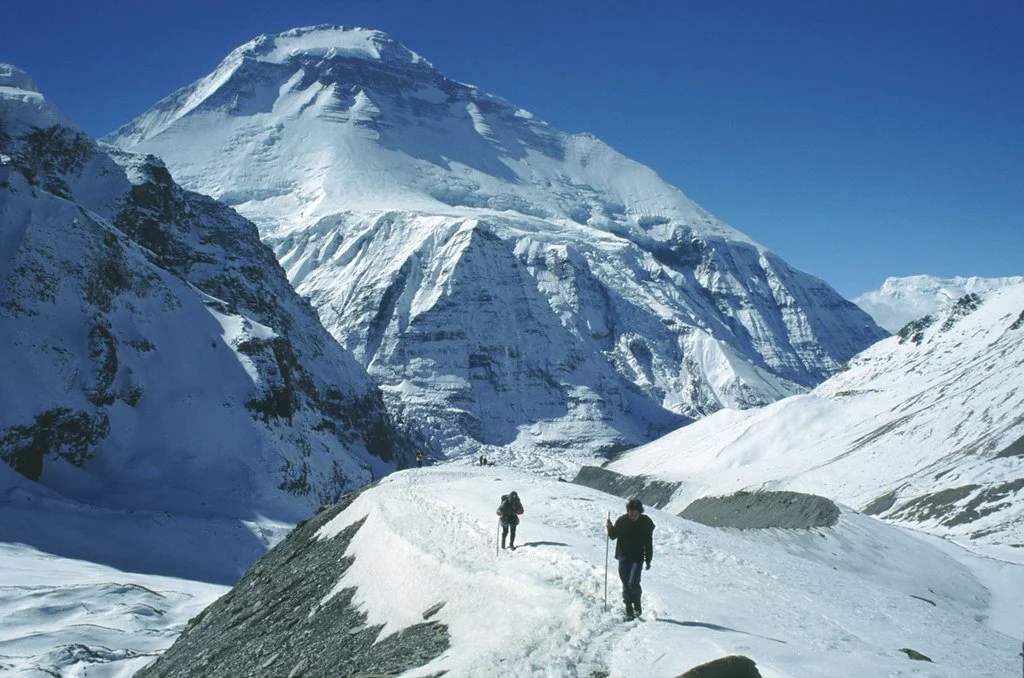
Dhaulagiri climbing route via the Northeast Ridge.
Climbing strategy
Rotations between camp 1 and 2
Summit push will be approached from camp 3
-
Summit day is the hardest day of the expedition.
We typically start around 7:00 PM from Camp 3, climbing steep snow and ice for 10+ hours to the summit (conditions dependent). Then comes the real test: descending safely and efficiently.
Expect roughly:
10+ hours up
4-5 hours down, usually to Camp 2 or Camp 3 depending on conditions and team status
You must be prepared for a 15+ hour day in the Death Zone. That’s the reality.
-
We will have 10 days of contingency days for Dhaulagiri climb
-
No. Annapurna I is an advanced level / expert-only 8000m expedition.
-
At minimum: several 4000M - 6000m and one or more 7000m (or 8000m+) expedition background. NAMAS lists example prerequisites and expects prior time in real alpine systems (not just trekking)
-
North West Ridge via the Dutch Rib (north side).
-
NAMAS lists a standard ladder of camps (with typical altitudes):
BC 4,190m
C1 5,150m
C2 5,700m
C3 6,500m
Summit 8,091m
-
Rotations between camp 1 and 2. Then we make the push ffrom camp 3. The strategy is to minimize time in hazard corridors. We build camps and fix lines where required, but the winning strategy on Annapurna is not “slow and steady.” It’s smart timing + efficient movement + fast execution when the mountain gives a window.
-
Yes. We build the itinerary with enough flexibility to wait for the right window and adapt to changing conditions.
Annapurna I requires patience. We will not rush a summit push if route stability or weather is wrong. We strongly recommend booking flexible return flights, because rigid travel plans create pressure—and pressure is how climbers make bad decisions.
-
Dhaulagiri I is a serious and committing expedition, and we do not recommend it as a first 8000m peak. Due to its technical terrain, demanding weather, and sustained exposure, climbers should arrive with a proven high-altitude background.
This expedition is best suited to mountaineers who have already completed an entry-level 8000m peak such as Manaslu or Cho Oyu, or who have built strong experience on technical 6000m–7000m peaks such as Ama Dablam, Himlung Himal, Baruntse, or similar objectives.
Beyond summit experience, you should also be comfortable with expedition life, fixed lines, cramponing on steep terrain, and operating effectively in harsh high-altitude environments.
If you are unsure whether Dhaulagiri matches your current level, our team will be happy to review your climbing background and advise honestly.
Team, Ratios, Logistics & Training
-
We keep teams small and controlled: maximum 8 climbers.
1 lead guide: IFMGA / NMA certified (Nepal-based leadership first)
We believe modern Nepalese IFMGA/NMA guides are fully capable at the highest level—and we prioritize responsible leadership development in Nepal.
Sherpa ratio: 1:1 Sherpa-to-client
Our Sherpas are NNMGA / Khumbu Climbing Center trained, with extensive 8,000m experience. English level is typically intermediate—clear enough for instruction, safety checks, and coordination under stress.A fully dedicated “personal Sherpa” arrangement can be organized if requested (additional cost), depending on your support plan.
-
NAMAS lists IFMGA or NNMGA-certified leadership (depending on package) plus a high-altitude Sherpa team.
-
Small-team strategy: 1 to 8 climbers.
-
Most guests tip at the end of the expedition.
Your booking already includes a $1,000 tip pool, which we distribute fairly among drivers, porters, kitchen staff, and support team.
Many guests also choose to:
Donate usable gear (jackets, trekking poles, gloves, hats)
Host a final team dinner as a gesture of respect
Suggested summit bonus: $1,500+ (for your 1:1 climbing Sherpa), depending on performance, effort, and your overall arrangement.
-
This is not a mountain for “first-time high altitude climbers.”
You should have:
Prior high-altitude expedition experience: Multiple 4000M - 6,500m+
7,000m+, and preferably at least one 8,000m attempt or summit
Strong rope and systems discipline
Critical skills include:
Abseiling / rappelling, including multi-pitch efficiency
Confident movement on mixed terrain: snow, ice, rock, slabs, scrambling
Strong crampon and ice axe technique: front-pointing, balance, secure descending
Self-arrest competency and stability on steep snow
Ability to manage your body at altitude: hydration, appetite, sleep, pacing
Rock climbing benchmark: 6B to 7A+
(Grades are only useful if your alpine performance matches.) -
Minimum 2 / Maximum 8.
Small teams move better, make safer decisions, and avoid chaos on a serious face like Annapurna. -
This expedition is for climbers 18+ with relevant high-altitude and technical experience who are ready for an expert-level 8,000m objective.
-
We allow 60kg of personal gear for this expedition.
-
Yes. NAMAS inclusions list:
Signature: 4 oxygen bottles
Classic: 3 oxygen bottles
-
Evacuation is listed as excluded / billed to your account, so you must carry appropriate insurance coverage. Generally emergency evacuations are covered by your insurance.
-
Yes, it can be arranged depending on the itinerary and your support plan. Email us and we’ll advise the best logistics.
-
Yes. Private expeditions can be arranged within the correct season. Additional cost applies due to dedicated logistics, staffing, and custom planning.
-
You must be in excellent shape. Annapurna is technically demanding and physically punishing.
Sherpa support is strong, but on this mountain you’re still expected to:
Carry your personal kit during rotations
Move efficiently for hours on steep terrain
Recover quickly and consistently across weeks at altitude
-
You should commit to a 6–12 month training block that includes:
Endurance base (long aerobic work)
Strength (legs + trunk + posterior chain)
Weighted uphill carries (your expedition currency)
Bouldering / rope climbing sessions weekly
Ice climbing / mountaineering course (crampons, ice axe, rope systems)
Real mountain days whenever possible (not just gym fitness)
If you want a structured approach, we can point you to our training resources and help you build a roadmap aligned to your current level.
-
Typically 10–15kg during acclimatization movements, depending on the day and what you’re carrying. We stage gear in camp tents to reduce unnecessary loads and keep your movement efficient.
-
We will provide a 16 weeks training program designed for 8000M peaks once booked with our team.
Additionally, we’ve written detailed guides on training for mountaineering to help you build a plan that matches the reality of long days, steep terrain, and high altitude.
Use that as your baseline—and then we’ll tailor expectations based on your experience and objective.