


Your Road to Everest: The Proven 4-Stage Training System
A 4-Stage Preparation Plan + Everest Summit Stage (Built Around You)
Everest isn’t a single expedition. It’s a journey you earn. If you’re serious about standing on the summit of Mount Everest—safely, confidently, and with the right team—this program gives you the structure most climbers never get: a progressive pathway that turns ambition into real capability.
At NAMAS, we help you identify where you are today, map the fastest safe route forward, and guide you through the right climbs—until you’re ready to step onto Everest with confidence.
WHO THIS IS FOR (AND WHO IT’S NOT)
This is for you if:
Everest is a serious goal (1 - 5 years) and you want a real plan, not vague advice.
You want to climb with measurable readiness gates (fitness, skills, altitude performance).
You prefer preparation over hype and you’re willing to do the work.
This is not for you if:
You want Everest “as fast as possible” without building skills and experience.
You are shopping purely on the lowest price.
You want a guarantee. In mountaineering, nobody honest offers that.
A Structured Path to the Top of the World
Our proven four-stage roadmap equips you with the technical skills, high-altitude experience, and cultural insight needed to summit Everest — safely and successfully. Led by our elite Sherpa team and seasoned expedition leaders, you’ll gain hands-on mountaineering knowledge while building the resilience and mindset required for 8000M peaks.
This isn't just about the summit. It’s about personal transformation, deep connection with the Himalayan landscape, and shared adventure with a team that’s climbed it all.
✔️ Build skills through progressive climbs
✔️ Train with the best in the business
✔️ Embrace the Everest region’s rich culture
✔️ Reach the summit within 1-5 years, depending on your starting point
Let us walk you through the five stages of our program:
Foundation Stage: Lay the bedrock of your mountaineering prowess as you develop essential skills, undergo physical conditioning, and engage in introductory expeditions to smaller peaks. This stage establishes a strong base upon which to build your future accomplishments.
Intermediate Stage: Progressing further, this stage delves into semi-technical training, altitude acclimatization, and expeditions to peaks surpassing 6000 meters. It prepares you for more demanding endeavors, equipping you with the necessary skills to surmount greater challenges.
Advanced Stage: At this juncture, you'll confront heights exceeding 7000 meters, honing your climbing techniques, fortifying your mental resilience, and gaining invaluable experience in extreme environments. This stage mirrors real-world expedition scenarios, encompassing base camp and climbing strategies while immersing you in the rigors of extended days in the mountains.
Advanced Plus Stage: In this amplified stage, you will encounter even more rigorous challenges, enabling you to fortify your expertise, cultivate mental resilience, and develop the unwavering determination required to conquer extreme altitudes.
Summit Everest/Lhotse: The crowning achievement of your journey, this stage is wholly dedicated to the ultimate test—the triumphant summiting of Mt. Everest. Guided by our seasoned experts and bolstered by our unwavering support, you will ascend to the zenith of the world's highest peak, breathing life into your long-cherished dream.
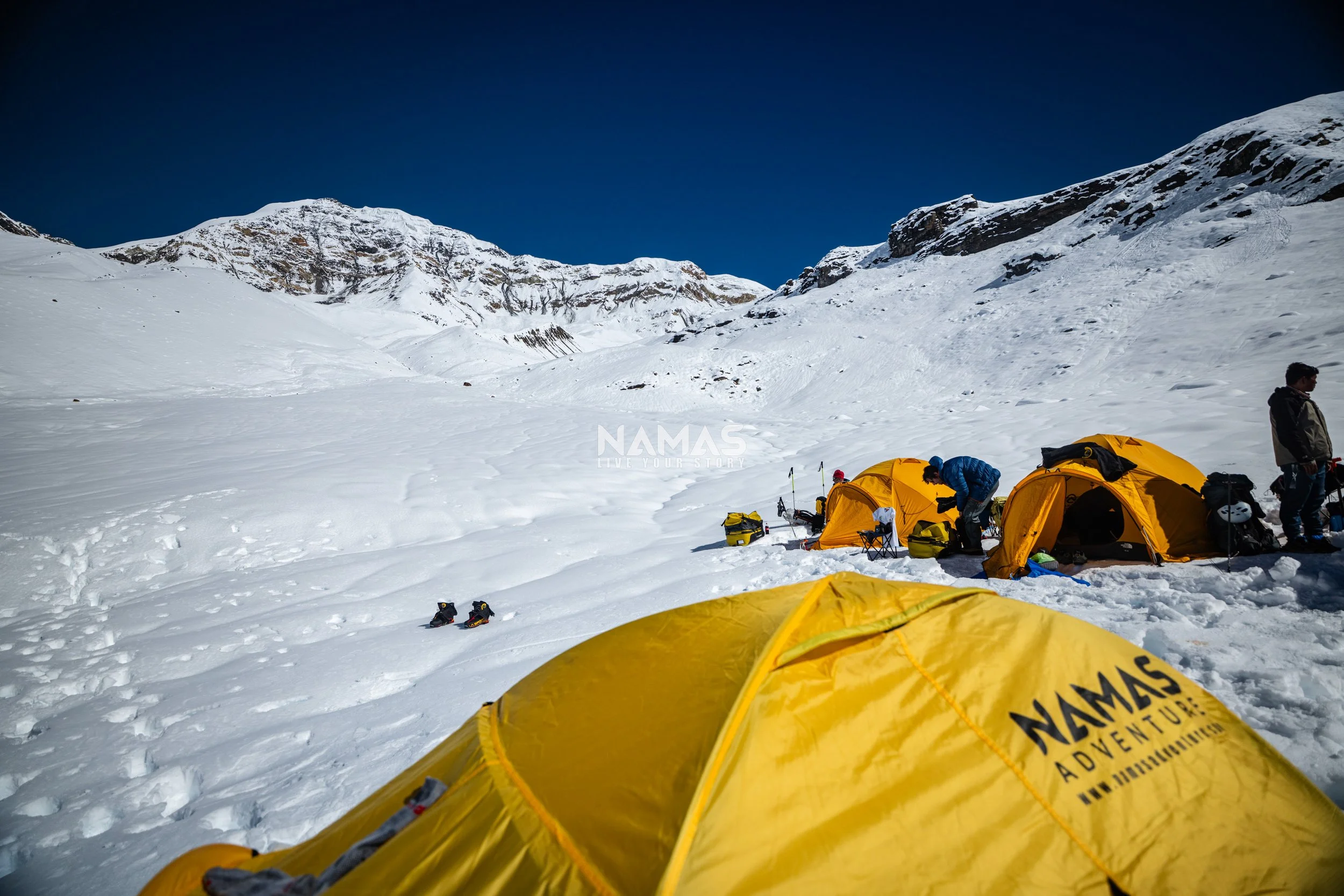
Stage 1 - Foundation
Overview
Altitude: 4000M - 6000M
Climbers’ experience level: Beginner Novice level Experience
Location:Nepal Chulu Far East 6019M
When to climb?: March - December
Total no of days: 6 - 15 Days
Difficulty grading: 1B (Alpine grading info)
Accommodation: Tea houses, huts and alpine camps
Welcome to the starting point of your thrilling and exhilarating journey toward conquering the mighty Everest. The path ahead is filled with adventure and excitement, and you have the power to choose where this incredible expedition begins. At Namas Adventure, we offer Mountaineering Courses that pave the way for your ascent. Begin with our Level 1 course, held in the picturesque landscapes of Nepal or Peru, and let the magic unfold.
Led by our team of highly skilled and locally certified guides, including IFMGA or NNMGA professionals, these courses are designed to equip you with the essential knowledge and skills required for mountaineering. As you complete our Level 1 course, you will emerge armed with confidence, ready to take on the challenges that lie ahead.
Key Learning Outcomes:
Learning Belaying, Rappelling/Abseiling Techniques
Proficiency in Crampon and Ice Axe Skills
Introduction to Alpine Mixed Climbing
Development of Multi-pitch Climbing Skills
Understanding of Glacier Rescue Techniques and Recovery in the Event of a Crevasse Fall
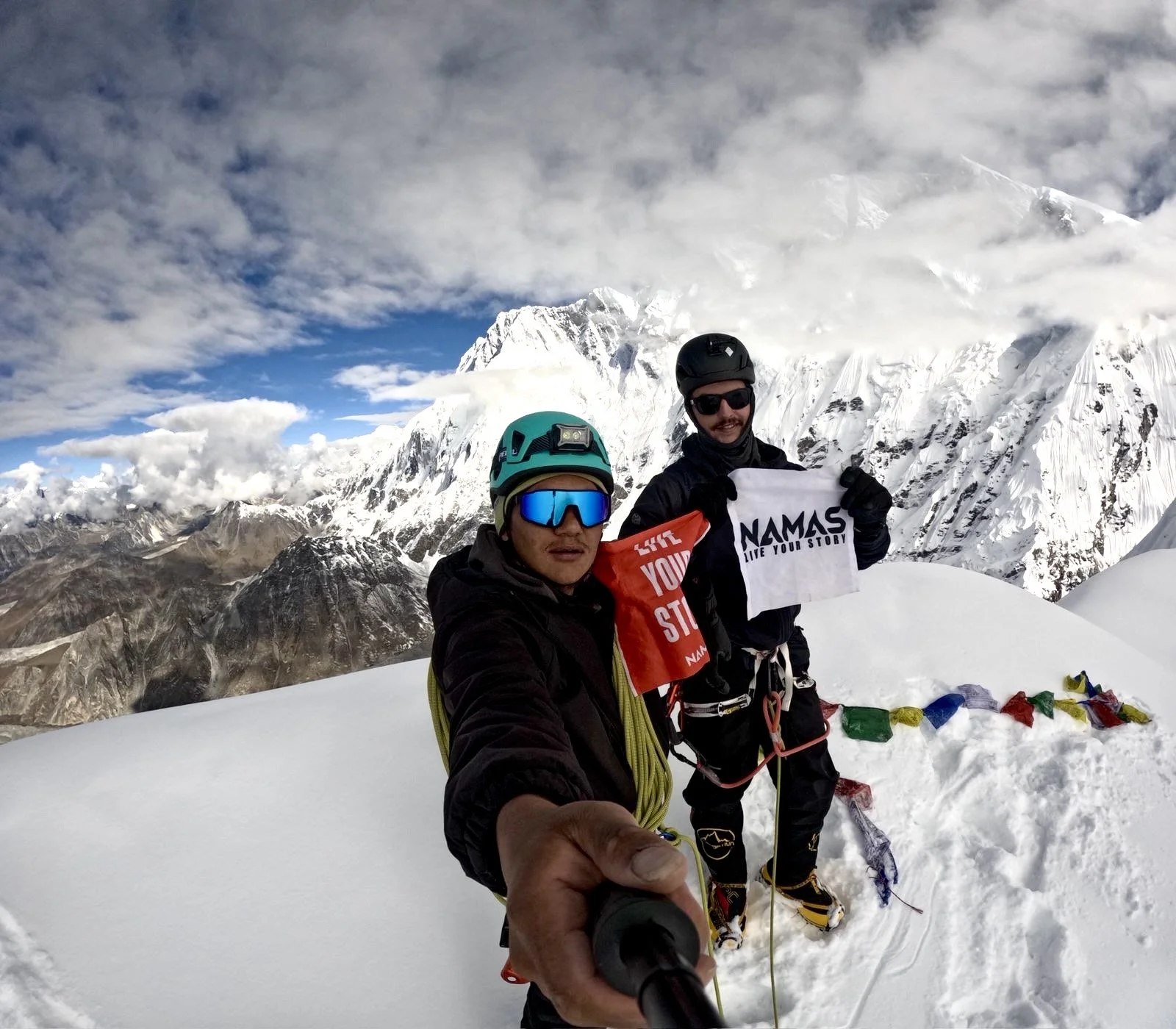
Stage 2 - Beginner to Intermediate
Overview
Altitude: 6000M+
Climber’s experience level: Beginner/Intermediate Level
Location: Nepal
When to climb?: March-May or September - November
Total no of days: 12 - 30 days
Difficulty grading: PD-AD / 2 - 3 (Alpine grading info)
Accommodation: Lodges and Camping at Base camp and high camp
In Stage 2, it's time to apply the skills and training you've acquired along your journey. The breathtaking multiple 6000M+ awaits you in the magnificent Khumbu/Annapurna region. These climbs, suitable for beginners and intermediate climbers, will be pivotal in your development.
Scaling heights of 6000 meters and beyond, you'll put your endurance and strength to the test in the majestic Himalayas. These peaks serve as a vital opportunity for self-assessment, allowing you to gauge your fitness level and understand the level of preparation required for future challenges. Additionally, conquering these 6000M+ summits will add valuable accomplishments to your climbing portfolio.
Key Learning Outcomes:
Mastery of Abseiling Techniques in Higher Altitudes and Exposed Mountain Environments
Extended Proficiency in Climbing with Crampon and Ice Axe Skills
Successful Summiting of Two or more 6000M+ Peaks
Gain Essential Experience in Climbing Semi-Technical 6000M+ Peaks and Receive Feedback on Climber's Fitness Level, with a Focus on Endurance and Strength.
Suggested expeditions
Khumbu region - Lobuche East,Island Peak, combo peak or Khumbu 3 Peak
Annapurna region - Chulu West, Annapurna 3 Peak
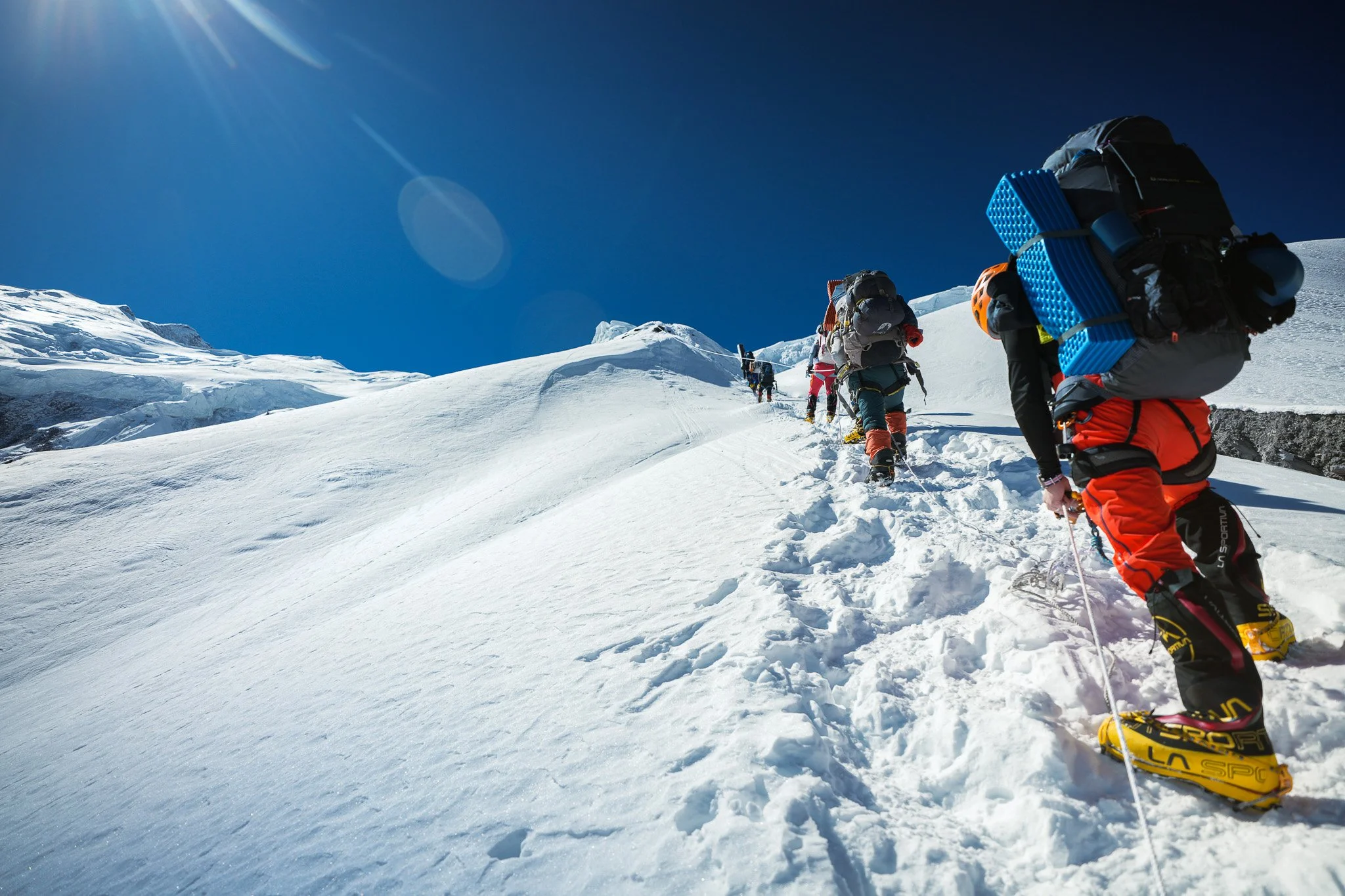
Stage 3 - Intermediate to Advanced
Overview
Altitude: 7100M/ 23,389 ft +
Climber’s experience level: Intermediate/Advanced level Experience
Location: Nepal, Argentina, Kyrgyzstan
When to climb?: Jan - Feb, April - May, July - August, October - November
Total no of days: 25 - 35 Days
Difficulty grading: 4 AD+ (Alpine grading info)
Accommodation: Lodges and High Camps 1 - 2
Stage 3 is a critical milestone often overlooked by climbers aspiring to conquer 8000M+ expeditions. We firmly believe that gaining experience in climbing 7000M+ peaks is of utmost importance. In this stage, we aim to enhance your expertise by not only preparing you for more demanding summits but also instill the confidence required to undertake greater challenges. This stage will also offer insights into the intricacies of expedition planning, albeit on a smaller scale compared to Everest. It will serve as another endurance and strength test, pushing your fitness levels to new heights.
Key learning outcomes:
Enhanced proficiency in ascending fixed ropes using the jumar technique and extended practice in rappelling/abseiling.
Mastery of crampon and ice axe skills during longer-duration climbs.
Successful summiting of two peaks at the 6000M and 7000M altitudes.
Exposure to the planning and strategic aspects of mountain expeditions on a smaller scale.
Acquire essential experience in ascending semi-technical 7000M+ peaks while receiving valuable feedback on climbers' fitness levels, particularly endurance, and strength.
Suggested expeditions
Barun or Khumbu region, Nepal - Baruntse, Ama Dablam
Annapurna region, Nepal - Himlung Himal, Tilicho Peak, Annapurna IV
Kyrgyzstan - Lenin Peak
Argentina - Aconcagua
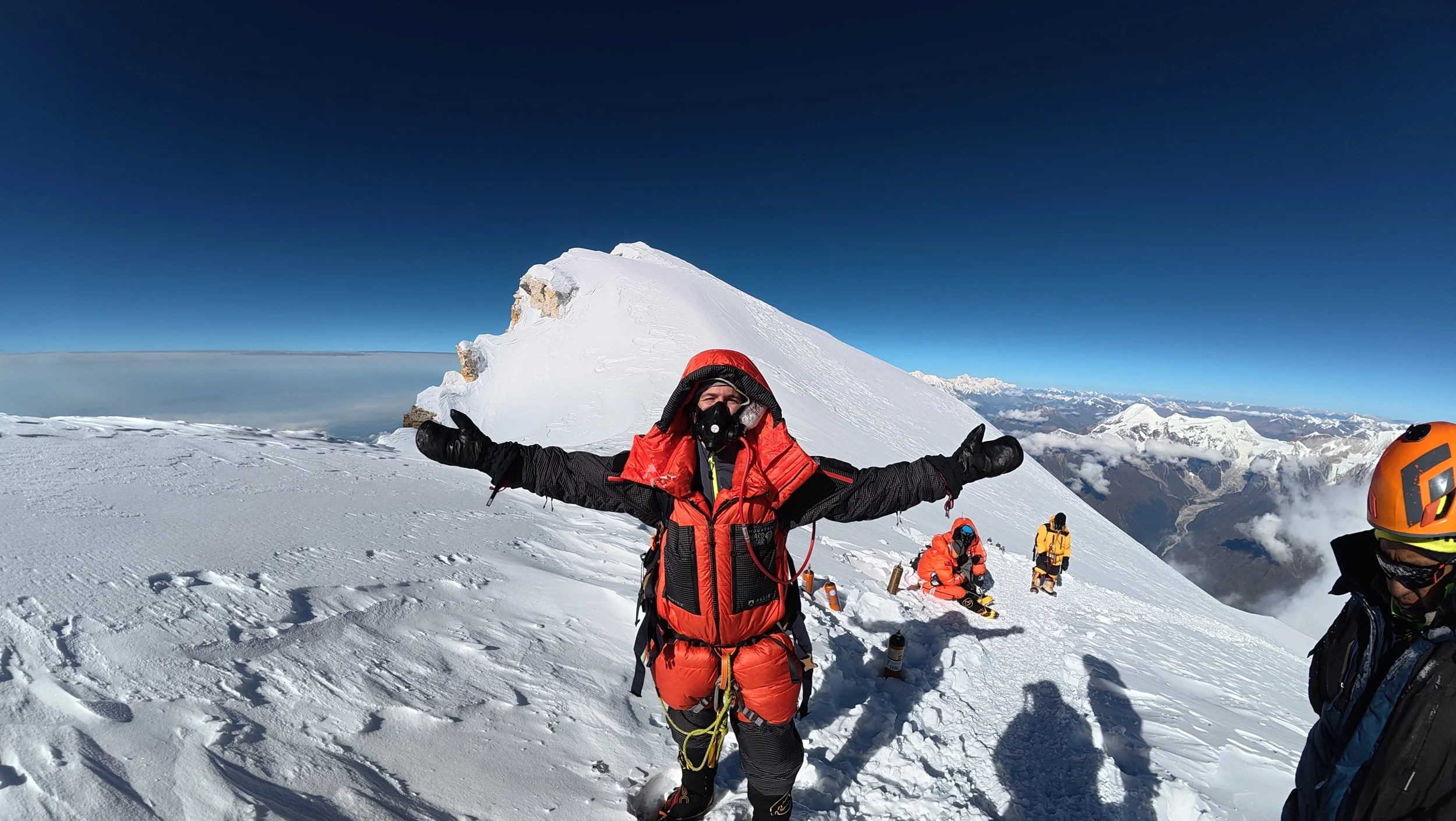
Stage 4 - Advanced plus+
Overview
Altitude: 7500M+ to 8000M
Climbers experience level: Advanced level Experience
Location: Nepal
When to climb?: August - October
Difficulty grading: TD/ 4 - 5 (Alpine grading info)
Accommodation: Lodges and Camping at BC/Camp 1 - 4
By reaching this stage in the program, climbers will have acquired all the essential skills and knowledge necessary for ascending to the 7000M altitude range and comprehending the intricacies of larger and more demanding expeditions. Manaslu Expedition will serve as the initial foray into the realm of climbing within the perilous death zone altitude, offering a profound and unparalleled experience.
Operating and planning this expedition will mirror the meticulousness and intricacy of an Everest Expedition. Climbers will immerse themselves in the ambiance of a major ongoing expedition, fully immersing themselves in the environment. Embodying the characteristics of an extreme high-altitude mountain, climbers will encounter steep hazards, endure long climbing days, navigate through the challenges of four high-altitude camps, and conquer the heights of extreme altitudes. This monumental experience will serve as the final piece in your journey, paving the way for your ascent of Mt. Everest.
If you are seeking an affordable option, almost half the cost of the Manaslu Expedition, that still provides an exhilarating extreme altitude climb, Annapurna IV is another final recommended option to take upon before we finally set off for Mount Everest/Lhotse or any other challenging 8000M+ expeditions.
Key learning outcomes
Advanced Mastery of Belay, Rappel, and Abseiling. Confidence in belaying, rappelling, and abseiling techniques, surpassing the proficiency attained in previous stages. These essential skills will enable you to navigate more challenging and complex terrain with confidence and precision.
Acquiring Extreme High-Altitude Climbing Experience. The extreme conditions and unique demands of climbing at these extraordinary heights, enhance your knowledge and expertise in handling the challenges associated with high-altitude environments.
Extreme High-Altitude Alpine Camping: Engage in 3 to 4 exhilarating extreme high-altitude alpine camping expeditions.
Understanding Expedition Planning and Strategy: Experience the intricacies of planning and strategizing for major expeditions.
Climbing 7500M to 8000M+ Peaks. Gain the necessary experience and skills to ascend formidable peaks exceeding 8000 meters, including the remarkable accomplishment of summiting Manaslu the 8th highest peak or Annapurna IV 7525M. This significant achievement will further enrich your climbing portfolio and provide invaluable insights into the physical fitness levels required for successful 8000M+ expeditions. Specifically, you will deepen your understanding of the crucial components of endurance and strength necessary to conquer the most challenging climbs.
Suggested expeditions
Annapurna region, Nepal - Annapurna IV 7525M
Manaslu region, Nepal - Manaslu 8163M, Manaslu express

STAGE 5 - Summit EVEREST 8848M
FINAL STAGE 5 - Summit EVEREST 8848M
Overview
Altitude: 8848M/ 23,389 ft
Acclimatization peak: Lobuche East 6119M
Climbers experience level: Advanced level Experience
Location: Khumbu Region
When to climb?: April - May
Total no of days: 60 Days
Difficulty grading: ED / 5 (Alpine grading info)
Accommodation: Lodges and Camping at Everest BC/Camp 1 - 4
Adds on: 🏔 Lhotse 8516M
As you enter the remarkable 5th stage of your journey, envision yourself mentally and physically equipped with the perfect blend of experience and readiness to conquer the mighty Mt.Everest 8848M and Lhotse 8516M. Your commitment to thorough preparation and unwavering dedication to your training plan since your last expedition has brought you to this defining moment. The Everest expedition awaits, spanning 60 days of unparalleled adventure that will etch everlasting memories in your heart.
By now, you are intimately familiar with our expedition approach, having shared remarkable moments and forged deep bonds during our previous climbs. The trust and understanding we have nurtured together have become the bedrock of our collective journey. Our team has come to know you on a profound level throughout these transformative years of climbing, enabling us to comprehend your strengths and weaknesses and guide you toward achieving your dream summit on Everest.
Frequently Asked Questions
-
-
Yes—if climbing from the China (North/Tibet) side, an 8000m peak is mandatory.
From the Nepal (South) side, it is not an official requirement. However, at NAMAS, we strongly believe prior experience on a lower, less technical 8000m peak (such as Manaslu or Cho Oyu) is ideal preparation.Alternatively, advanced 7000m peaks—like Annapurna IV or Nuptse—can equally prepare you for Everest and also meet the mandatory 7000m experience requirement, building the skills, confidence, and decision-making needed at extreme altitude.
-
Failing a stage is not a failure — it’s part of the progression. If this happens, we reassess, adjust your plan, and focus on strengthening the areas that need work.
The goal is long-term readiness and safety, not rushing timelines. It’s not only about summiting — it’s about preparing properly for the ultimate objective of climbing Everest. If a 7000m summit isn’t achieved, we can re-strategize and recommend alternative objectives that still fulfil permit requirements while building the right experience.
-
Yes — but only after proper progression.
Once you’ve successfully completed Stage 4 or have the necessary high-altitude experience, you may be eligible to join our Everest Express program. This option is available only to well-prepared climbers who meet our performance, acclimatization, and safety criteria. -
We determine your starting stage through a review of your previous climbing experience, altitude history, fitness level, technical skills, and overall readiness. This may include discussions, training data, and performance on recent climbs. The goal is to place you at the stage that best supports safe progression and long-term success, not to rush the process.
-
Yes. Once you book an expedition with us, we provide a structured training plan tailored to your objective, experience level, and timeline—designed to prepare you safely and effectively for high-altitude climbing.
-
For most climbers, the best first climb in Nepal for Everest preparation is a 6000m expedition, such as Mera Peak or a 6000m combo like the Annapurna 5X Summit or Khumbu 3 Peaks. These builds altitude exposure, movement efficiency, and acclimatization habits in a controlled way.
-
No. You don’t need to be an experienced climber to start. Many Everest journeys begin with trekking peaks and structured 6000m climbs, combined with proper training and progression. What matters most is commitment, fitness, and a willingness to learn—the technical skills are developed step by step.
-
We build climbers step by step, prioritizing safety, preparation, and long-term success above all else. Our expeditions are intentionally small, led by highly experienced Sherpa teams and supported by founder-level leadership, ensuring clear decision-making and consistently high standards in the mountains.
We don’t just guide summits — we guide people toward becoming capable, confident mountaineers.
That also means we are willing to say no when someone wants to rush a timeline that doesn’t match their readiness. If a climber’s performance does not meet the real demands of Everest, we slow the process down. Safety, preparedness, and sustainable progression will always come before speed or pressure.
We’re not here simply to do business. We’re here to earn trust — and to build lasting confidence from the very first day someone joins NAMAS.
-
We evaluate your readiness by looking at a combination of experience, fitness, performance, and mindset. This typically includes your previous altitude history, technical skills, physical conditioning, acclimatization response, and how you perform under fatigue.
We also assess your decision-making, discipline, and ability to follow systems — not just your summit history.
-
There is no age limit for Everest.
What matters is your health, fitness, experience, and preparation, not your age. With the right progression and medical clearance, climbers well into their 60s—and beyond—have successfully summited Everest. -
Yes. You must be at least 16 years old to receive a permit and attempt Mount Everest. This is a formal requirement set by the authorities.
-
For most people, it’s multiple seasons. You can compress timelines only if you already have the base and solid experiences.
If you’re starting fresh, think in 24–26 months, not 6–12 months. 12 - 24 months can be enough for specific physical prep if you already have prior experience, but 2-5 years is often ideal for building durable readiness.
-
The fastest responsible path is the one where you don’t have to relearn basics at 6,000m.
Speed comes from competence: strong foundations, efficient movement, clean systems, and proof on 6000–7000m, lower 8000M before you gamble with Everest. Express programs on all the stages are the fastest option.
-
If you are a novice climber and lack technical/physical foundation is weak, yes.
A structured pathway starts with robust technical skills—snow/ice movement, rope handling, glacier travel, crevasse rescue—before chasing altitude.
-
That is a great base too but the world of mountaineering is different. Start with skills + a controlled 6000m objective such as Mera Peak, Lobuche East , Island Peak, Chulu West.
Your aim is to become safe, efficient, and coachable for higher objectives.
-
6000m peaks are the entry point into the physical and mental demands of mountaineering. They help build altitude discipline and expedition rhythm while you still have margin to learn. This is where you prove you can perform for multiple days, recover overnight, and keep your systems — body, mindset, and decision-making — intact.
-
Our recommendations are combo 6000m climbs that teach the core systems of mountaineering: fixed-line movement, cold management, repeated summit pushes, and multi-day load handling. Many established progression frameworks highlight Nepal options such as Island Peak & Lobuche East, Khumbu Three Peaks, and Annapurna 5× summit-style programs as strong introductions to high-altitude expeditions.
-
You’re ready when you can:
Move confidently on fixed lines, fully geared up (up and down) without wasting energy
Maintain hydration/nutrition in the cold
Recover well enough to perform again the next day
Stay healthy throughout the expedition (not just “survive” it)
-
You’ll need solid familiarity with rope systems—including glacier travel, crevasse rescue, rappelling, belaying, and fixed ropes—along with real-time movement in crampons across varied terrain.
-
We have clear, explicit requirements. One commonly referenced benchmark is around 15 - 20 days of movement in crampons across expeditions and climbs. At NAMAS, this isn’t a box to tick or a number to chase — it’s a reference point for seriousness, readiness, and time spent learning in real conditions.
-
Often, yes — because it demonstrates your understanding of a full-scale expedition: logistics, recovery, storm management, mental durability, and sustained performance under load. At NAMAS, we explicitly look for one or two major expedition peaks in a candidate’s background, as this experience is critical to long-term readiness and decision-making at higher altitude.
-
-
It means you performed consistently throughout the expedition — staying healthy, moving efficiently on fixed ropes, and demonstrating the mental grit the mountain demands. You handled the pressure, adapted to what the mountain threw at you, prepared thoroughly, and operated independently — without relying on luck or rescue-level intervention to function.
-
There are two ways to look at this:
From the China/Tibet (North) side: Yes, an 8000m peak is an official requirement.
From the Nepal (South) side: No, the formal requirement is 7000m summits in Nepal (see our blog post for full context).
That said, at NAMAS, we strongly recommend completing a lower, less technical 8000m peak (such as Manaslu or Cho Oyu). While not mandatory from Nepal, it is a major advantage.
-
It shows how your body behaves when recovery is impaired, how you operate critical systems in the death-zone environment—where everything slows down—and how you make decisions when you’re exhausted and the summit is still hours away. It also reveals how your body adapts in extreme conditions: your pace, nutrition patterns, limits without supplemental oxygen, and how effectively you work with your guide under sustained stress.
-
A failed summit isn’t a failure if your execution was strong and the decision was correct. What matters is why you didn’t summit
Weather/conditions (good decision)
Pace/system breakdown (fixable)
Illness pattern (serious—requires a better plan)
You don’t “upgrade” stages until the cause is addressed.
-
Train like a mountain endurance athlete. A credible framework is 6–12 months of focused prep for the next major objective, with longer horizons (often ~3 years) producing more robust outcomes for Everest.
-
Anyone who dreams of climbing Everest needs consistency, discipline, and determination to see the goal through.
That means training 4–5 days a week, combining aerobic conditioning, muscular endurance, and strength work to build the capacity required for high-altitude expeditions.
-
Yes — but it must be guided and monitored by specialists. DIY approaches are strongly discouraged.
Hypoxic pre-acclimatization can help—especially for those limited by time off—by improving tolerance to altitude stress before an expedition. However, it is not a substitute for real mountain skills, experience, or time at altitude.
Most programs use normobaric hypoxia, typically by sleeping in a hypoxic tent, as a supplement to proper training and on-mountain progression.
-
Yes — for people with limited vacation time, your roadmap is designed for efficiency:
Express programs are built for climbers with limited time
They reduce standard timelines by ~50–60% through structured progression
One major objective per season, clearly defined
Pre-acclimatization / hypoxic training before each expedition
Specialised coaching, monitoring, and support
That said, shortcuts without competence aren’t efficient — they’re expensive risk.
-
We look for proof, not promises: performance history, technical competence, and how you hold up across multiple days at altitude. We formally review your climbing resumes before acceptance.
-
People underestimate the journey cost: multiple expeditions, flights, gear, coaching, insurance, and time.
A transparent roadmap should show stage budget bands so you qualify yourself early and avoid unrealistic planning.
Depending on your choice of service the whole preprations can be quoted from USD 90K - USD 250K
Blog post for reference:
-
You should receive:
Your starting stage + the reason
Your next best expedition recommendation
A realistic timeline (Foundation / Standard / Accelerated)
Risk flags (skills/fitness/altitude response)
Clear next steps to move forward