

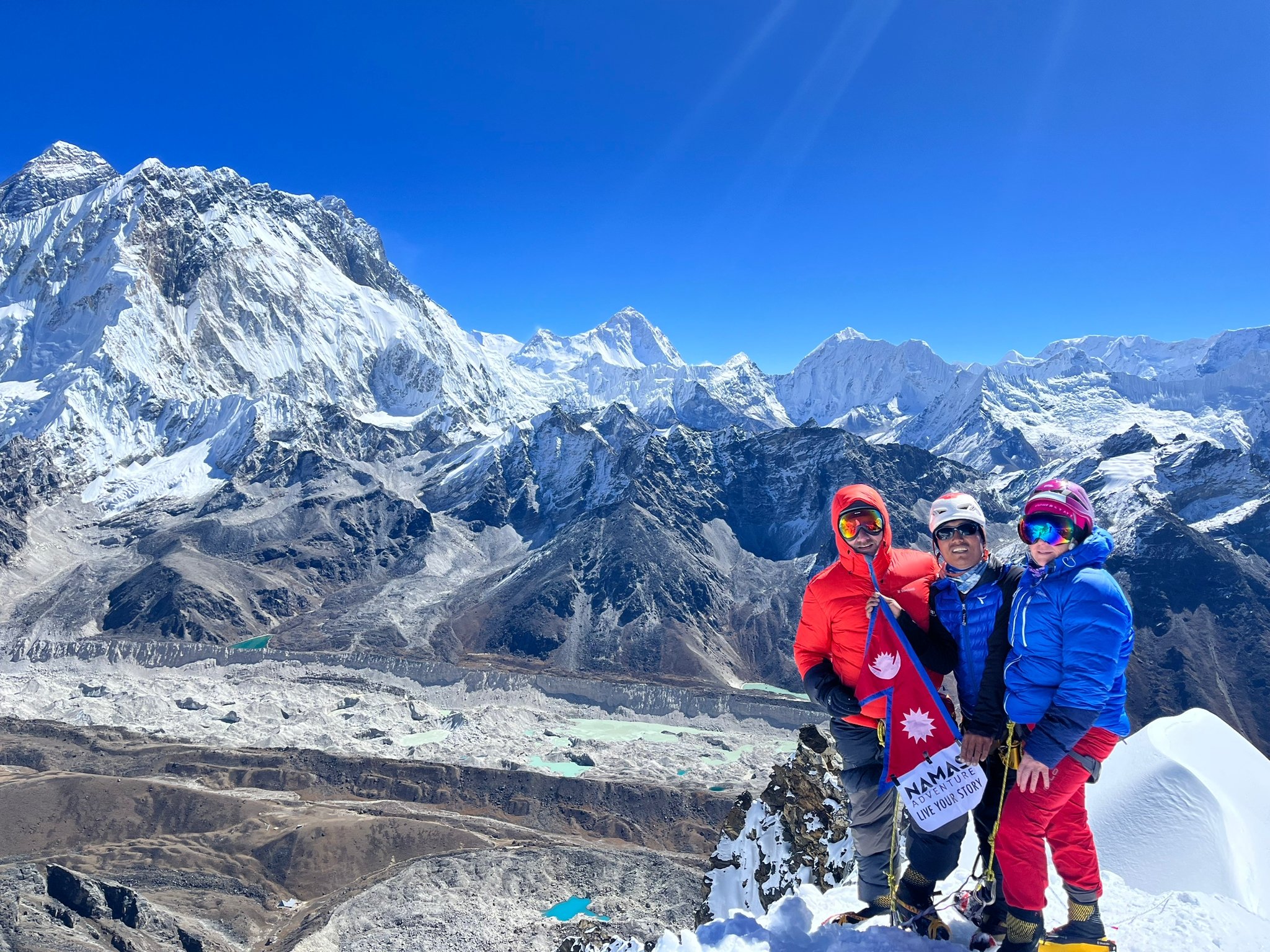
Lobuche East 6119M - Entry level semi-technical climb
Highlights
Lobuche East 6,119 Metres
13 Day Signature or 21 Day Classic Itinerary for Summit
Pooled Helicopter Flight Kathmanduto Lukla and circle back on Signature Climb
Khumbu Region Hiking Exploration with 360 Panoramic views of entire Himalayas, Gokyo lake, Cho-la-Pass
Ration of Client/Guide 1:2 for expedition
Training Peaks Championed 6000M peak training for 12 weeks
Base & High Camp alpine Camping.
Overview
Lobuche East Peak stands out as one of Nepal's most renowned climbing peaks exceeding 6,000 meters. This meticulously crafted Lobuche Peak Climb 21 Day Expedition Itinerary offers a gradual acclimatization process, guiding you through the Khumbu Valley, ascending towards Everest Base Camp, and steadily advancing toward the summit of Lobuche East Peak. Notably, this peak serves as a crucial training ground for Everest summit teams, aiding in their preparation before embarking on the ultimate ascent.
The Technical Aspects of Lobuche Peak Climb: Lobuche East Peak holds a PD alpine grading, encompassing elements of technical climbing and intricate glaciers. Prospective participants of this expedition should possess foundational mountaineering experience, encompassing skills like rock scrambling and maneuvering on snow/ice using an ice axe and crampons. It is strongly advised that individuals have prior exposure to basic winter or alpine courses involving the use of ice axe and crampons, as these form the fundamental technical prerequisites for the final summit push. While a dedicated skills day will be incorporated into the trip, its purpose primarily revolves around refreshing existing knowledge.
-
Autumn 2026
28th September - 10th October (8 spots)
18th - 30th October
Spring 2027
6th - 18th March
3rd - 15th April
27th April - 9th May
Autumn 2027
26th September - 8th October
1st November - 15th November
28th September - 5th October
Dates not matching your schedule? Book a tailored private climb.
-
Autumn 2026
28th September - 18th October (8 spots)
18th October- 7th November
Spring 2027
6th - 26th March
3rd - 23nd April
27th April - 17th May
Autumn 2027
26th September - 16th October
1st November - 21th November
Dates not matching your schedule? Book a tailored private climb.
-
US $’s 6,350 per climber for Signature
US $’s 5750 for individual climber for Classic
Deposit required: $200 | £150 | €150 p/p
Please inquire about prices in your local currency. We accept payment in £GBP/ €EUROS/ $AUD
Absolutely Zero Hidden fees.
-
NMA (Nepal Mountaineering Association) Certified Sherpa Leader and Guide
1:2 Sherpa ratio
Shared Helicopter 🚁 travel Kathmanduto Lukla and Lukla to Kathmandu
Hotel 🏨stay in 5 star level amenity with a private room 2 nights before departure and 1 night upon return in capital city Kathmandu. (Please be Notified: If the expedition ends early with quick return to Kathmanduthen hotel charges for extra stays needs to be paid by climber)
A deeply Spiritual and rejuvenating recovery oriented 90 min massage at KathmanduHotel upon return.
Tips for Porter team
NAMAS Exclusive Branded Alpine Clothing Gears (Premium Goose Down Feather jackets, buffs and head caps,)
12 weeks structured high elevation climbing training Programme offered exclusively under Training Peaks.
Top Grade Mountaineering Gears like Sleeping bag of -23°C to 30°C from Kailas Mountain or -40°C to 40°F, Kantz Crampons, Mountaineering Helmet, Harnesses, 3 pairs of Carbiners, Duffels for carry, Ascenders and exclusively Z-lite Camping Mat.
Culinary cooks and kitchen hands for both base and high camps.
30 kgs of Individual climber’s personal essentials covered by the package. (Any Additional personal gears will require an extra porter at approximately USD 500 for a total of 17 days)
Sagarmatha National Park (Khumbu Region), TIMS, climbing and all other essential permits.
All local transportations fees on travel requirements to and from trailhead is included.
All day meals (which is breakfast, lunch and dinner) for trekking alongside expedition days.
A warm pot of hot water for consumption every night on climb days.
All lodging payments in teahouses during the trek.
Expedition Group porter fees.
Departure and Arrival transport cruises.
Vital Basic First Aid Kit.
Dinner events on Welcome and Farewell days
-
NMA Certified Sherpa. Guests are welcome to personally present additional gratuities directly to our guides and porters.
Gratuities for the porter team
Namas branded expedition merchandise (Down Jacket, Cap, Buff, all yours to keep)
1:2 Sherpa ratio maintained throughout the expedition
12-week high-altitude training programme for 6000M via Training Peaks
Full mountaineering gear package (Kailas Mountain 900 Down Sleeping Bag rated -23C/-30C or Everest outfit rated -40C/-40F, 12-Point Kantz Crampons, Climbing Helmet, Climbing Harness, 3 Carabiners, Z-Lite Sleeping Foam Mat, Large Duffle Bag, Ascender)
Dedicated cook and support team stationed at Base Camp and High Camp
30kg personal luggage allowance per climber. Additional weight requires a supplementary porter, estimated at USD 500 for 17 days.
Two nights pre-expedition and one night post-expedition hotel accommodation in Kathmandu. Clients departing ahead of schedule are responsible for any additional Kathmandu hotel costs.
All trekking and climbing permits, including Khumbu Region Permit and TIMS
All internal and local transportation to and from the trekking trailhead
Breakfast, lunch, and dinner throughout all trek and expedition days
One pot of hot water provided each evening
Lodge accommodation throughout the trek
Dedicated porter team
Airport arrival transfers and departure drop-off
All internal flights
Basic first aid kit
Welcome or farewell dinner
-
Visa fees and personal travel insurance
Summit bonus gratuity (USD 250 per member)
Personal entertainment and dining expenses in Kathmandu
Bottled drinks and personal beverages
Emergency evacuation costs (billed directly to the client's account)
Additional personal gratuities (service charges at hotels and restaurants are included in the expedition fee)
Single supplement fee, applicable only to clients booking without any fellow group members
Laundry, personal phone charges, and individual expenditures
Optional excursions
Tea breaks, snacks, chocolates, and any meals beyond the included breakfast, lunch, and dinner
Delays or cancellations resulting from natural phenomena
International flights to and from Kathmandu
-
Supplement Fee - USD 600
Applies When - Applicable when there is only one client member in the booking, with no fellow group members
Itinerary - Signature climb
Day 1 & 2 Arrival in Kathmandu. Equipment inspection and induction session with the Expedition Leader
Day 3 🚁 Shared helicopter: Kathmanduto Lukla, then trek to Monjo 2800M (5 to 7 hours)
Day 4 & 5 Namche Bazaar stay and Acclimatisation 3440M. Three-hour acclimatisation trek ascending to 3800M
Day 6 Namche to Phortse (5 to 6 hours)
Day 7 Phortse to Pheriche 4371M (5 to 6 hours)
Day 8 Pheriche to Lobuche Village or probably East Base Camp 4,910M (4 to 5 hours)
Day 9 Rest and skills training day
Day 10 Lobuche High Camp 5600M (5 to 6 hours)
Day 11 Summit Day 6118M, then descend to High Camp or Lobuche Village
Day 12 Shared 🚁 Helicopter. From Lobuche to Lukla to Kathmandu.
Day 13 Depart Day
-
Day 1 & 2 Arrival and Kathmandu. Equipment inspection and induction session with the Expedition Leader.
Day 3 Lukla to Monjo 2800M (5 to 7 hours)
Day 4 & 5 Namche Bazaar and Acclimatisation 3440M. Three-hour acclimatisation trek at an elevation of 3800M.
Day 6 Namche to Phortse 3880M (5 to 6 hours)
Day 7 Phortse to Machharmo 4400M (5 to 6 hours)
Day 8 Machharmo to Gokyo 4850M (5 to 6 hours)
Day 9 Morning hike to Gokyo Ri 5383M (3 to 4 hours)
Day 10 Gokyo to Thagnag 4700M (3 to 4 hours)
Day 11 Thagnag to Dzungla 4750M via Cho La Pass 5363M (7 to 8 hours)
Day 12 Skills training and Rest day
Day 13 To Lobuche High Camp 5600M (5 to 6 hours)
Day 14 Summit Day 6118M, then descend to High Camp or Lobuche Village
Day 15 Contingency Summit Day. Reserved in the event of adverse weather preventing a summit attempt on Day 14.
Day 16 Gorakshep and Everest Base Camp 5340M (7 to 8 hours)
Day 17 Kala Patthar 5545M, then descend to Pangboche 3600M (around 8 - 10 hours)
Day 18 Pangboche to Namche Bazaar 3440M (5 to 6 hours)
Day 19 Namche Bazaar to Lukla 2800M (6 to 8 hours)
Day 20 Lukla to Kathmandu
Day 21 Departure


HOW DOES IT WORK?
1. Initial Inquiry and Planning
At NAMAS Adventure, every expedition begins with understanding your goals and aspirations. From the very first conversation with our expert team, we offer personalised recommendations suited to your interests and experience level. Once the ideal expedition is identified, a deposit secures your place. From there, our team works closely alongside you to plan every detail, from gear selection and training guidance to securing insurance, permits, and full logistics.
2. Preparing for the Journey
As your expedition date draws near, our team helps you finalise all outstanding preparations. We collect the final balance payment, typically due 60 to 90 days prior to departure, confirm all documentation is in order, and address any remaining questions. Our team remains available by email and phone to ensure every climber departs feeling fully prepared and confident for the adventure ahead.
3. On-Expedition Support
Arrive at your destination ready to begin. From pre-expedition briefings and gear checks to the unwavering support of our experienced guides and ground crew throughout your climb, our team ensures everything runs smoothly. With the flexibility to adapt to changing conditions and unexpected needs, we are committed to delivering a seamless, enjoyable, and unforgettable expedition experience

FAQ's
When is the best time to climb Lobuche East?
Spring (March to May) is the premier season for climbing Lobuche East. Please note: the Everest region becomes exceptionally busy throughout April due to high-altitude mountaineering expeditions. Travel during June, July, or August is not recommended owing to heavy monsoon rainfall across Nepal. Autumn (September to November) is another excellent window for planning a Lobuche East climb.
Which route will the NAMAS team use? The mountain appears steep and exposed. What is your climbing strategy?
Lobuche East is a semi-technical peak within the Khumbu region and one of the most rewarding 6000m climbs available. Our itinerary features an extra rest and acclimatisation day at Base Camp, setting our climbers up for a strong and safe summit push. Our strategy follows the standard route via Base Camp and High Camp, using a methodical and well-paced approach proven across many successful expeditions.
How long is a typical day on the mountain?
On a standard climbing day, expect an average of six hours on the mountain. Summit day is the longest and most demanding, requiring an early start and a full descent back to camp once the summit has been reached.
What is summit day like?
Summit day on Lobuche East demands a strong physical and mental effort. Climbers ascend a steep vertical face toward the ridge before traversing it to reach the summit at 6118m. Significant crevasses are present along the route. Our guides will familiarise your team with technical rope and ladder techniques during practice sessions at Base Camp.
Can I see Mt. Everest from the Lobuche East summit?
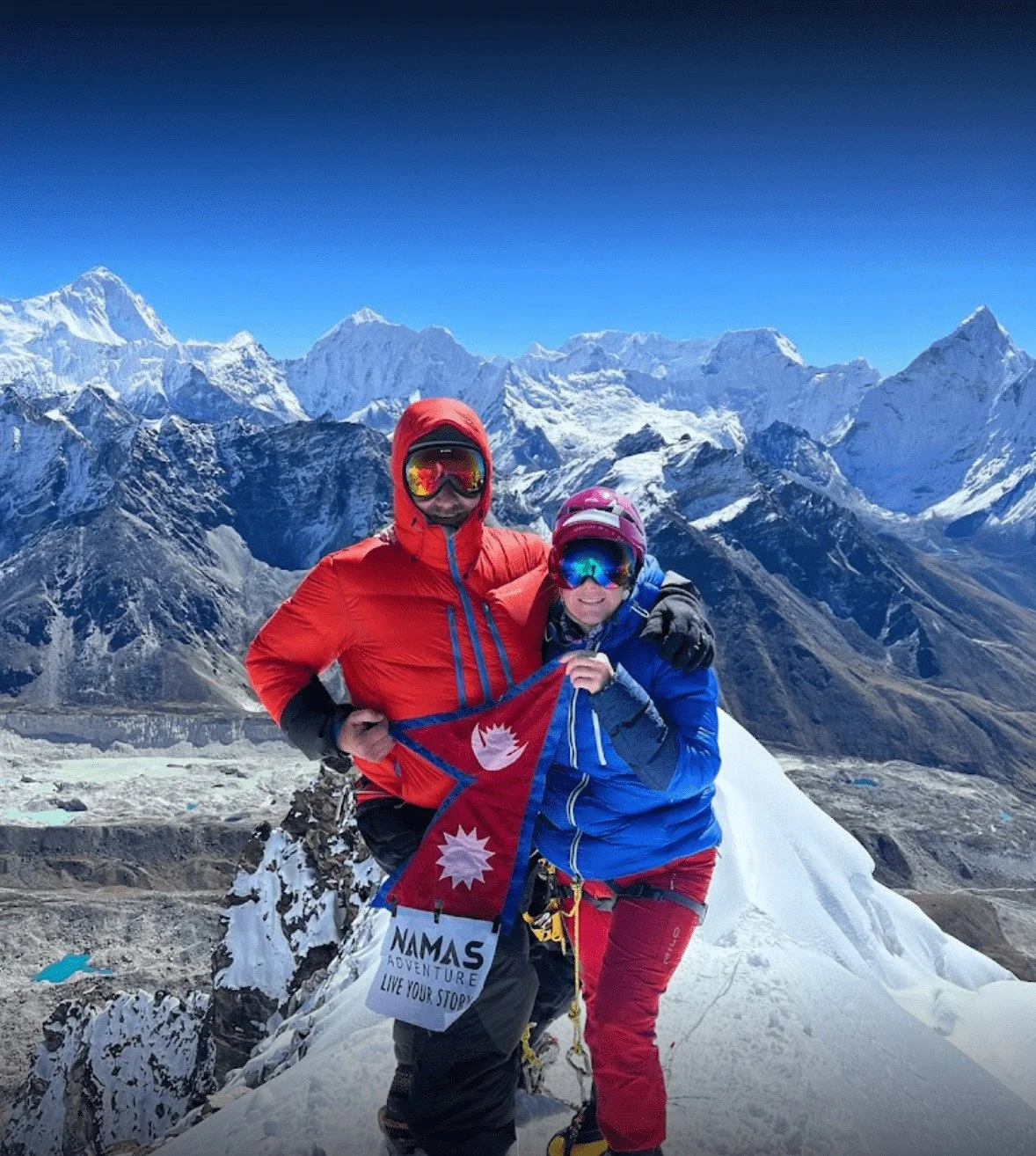
The Nuptse face partially obstructs the direct view of Everest; however, the 360-degree panoramic vistas from the summit encompass an extraordinary sweep of surrounding Himalayan peaks. The experience remains a true feast for the eyes and a remarkable personal achievement.
Are contingency days included during the Lobuche East climb?
One contingency day is built into the Classic Climb itinerary on Day 15, reserved specifically for adverse weather. The Signature Climb itinerary does not include a contingency day by default, though an extension can be arranged upon request should summit conditions prevent a successful attempt.
What are the guide and Sherpa qualifications, and what is their level of English?
Each expedition is led by a main guide who holds IFMGA or NMA certification. A Western IFMGA-certified guide can be arranged upon request at additional cost. NAMAS Adventure is firmly committed to responsible tourism and the elevation of local Nepalese leadership. Our Nepali IFMGA guides are highly capable and communicate in excellent English. Our Sherpa team holds NMA certification from the Khumbu Climbing Centre and communicates at an intermediate level, fully capable of instructing, advising, and responding in the field. A 1:2 Sherpa-to-client ratio is maintained throughout. Arrangements for a dedicated 1:1 personal Sherpa are available at additional cost.
How much in gratuities do you suggest for guides and porter teams? What about summit gratuities?
Most guests choose to present gratuities at the conclusion of the trek or climb. A tip pool of USD 300 is already incorporated into your booking fee, which our team distributes fairly among drivers, assistant guides, and porters. Many guests also donate trekking equipment such as jackets, trekking poles, gloves, or hats to our porter team, a gesture that is deeply appreciated. Treating porters to a farewell dinner on the final trek day is another wonderful tradition among our clients. A suggested additional summit gratuity of USD 200 per Sherpa guide is recommended.
Is Lobuche East suitable for beginner climbers, and what level of fitness is required?
Lobuche East is accessible to both novice and intermediate climbers. Reaching the 6118m summit requires foundational mountaineering skills including rope techniques, crampon use, abseiling, and ice axe handling. The peak is a highly popular destination for climbers with limited or no prior high-altitude experience. All participants are strongly encouraged to begin a dedicated fitness and conditioning programme three to four months before departure. Climbers should be capable of carrying a 5 to 8kg pack, walking uphill and downhill for up to 16 consecutive days, and pushing through the demands of summit day. Beyond physical readiness, the mental commitment to endure high-altitude exposure and unfamiliar conditions is equally important.
How do I know if Lobuche East is the right expedition for me?
Lobuche East is a 6000m peak adventure suited to beginner, novice, and intermediate climbers seeking a genuine high-altitude challenge. Our grading system can help determine whether the expedition is the right fit based on your current experience level. For any uncertainty, please contact our team directly. We will walk you through your experience profile and guide you toward the most appropriate expedition.
How many guides and Sherpas will be assigned to our group?
A 1:2 Sherpa guide ratio is maintained for the Lobuche East climb.
How many climbers are in a group?
Minimum two and maximum eight climbers per group.
Who is the expedition designed for?
Lobuche East is designed for all interested climbers aged 18 and above seeking a beginner to intermediate-level high-altitude experience. Participants aged 15 to 17 must be accompanied by a responsible adult throughout the expedition.
Who joins a Lobuche East expedition?
Climbers from across the globe, spanning diverse backgrounds, interests, and mountaineering skill levels, join our expeditions. The shared pursuit of the summit creates a uniquely powerful team dynamic.
Can friends or family join me on the trek to Base Camp or Everest Base Camp?
Yes, it is possible. Please contact our team by email with the relevant details and we will provide all necessary information and arrangements.
Can I contact other climbers to join the Lobuche East expedition?
Absolutely, and we actively encourage it. Whether it is a long-time adventure companion, someone met on a previous expedition, or a friend you believe would relish the challenge, building the team in advance makes for a stronger and more rewarding climb.
What is the baggage allowance for the Lobuche East expedition?
Namas Adventure provides a 30kg personal luggage allowance per climber for the Classic Climb programme.
Is a private Lobuche East climb possible?
Private Lobuche East expeditions can be arranged for groups at any point within the suitable climbing season. Additional costs apply to cover separate logistical planning and dedicated team resources. Please contact our team to discuss private expedition requests.
What fitness and conditioning level is required?
Climbers must arrive in excellent physical condition. Although our expedition is fully supported by Sherpa guides and fixed ropes, the technical and high-altitude nature of the climb demands that every participant is performing at their physical peak.
Are technical mountaineering skills required for Lobuche East?
No prior technical mountaineering experience is mandatory, though any prior skills or training will serve as a valuable foundation and add confidence on the mountain.
How difficult is the summit of Lobuche East?
Lobuche East is graded Alpine 2B. The fitter and stronger a climber is, the greater the likelihood of a successful and enjoyable summit experience. A successful summit is ultimately determined by weather conditions and individual fitness levels. The summit day typically begins around 3 to 4am with a three to four-hour ascent. For most climbers, the ascent is technically manageable, with proper acclimatisation being the single most important factor.
How heavy will my backpack be?
Climbers carry only their personal items on the mountain. All heavy technical gear and group equipment is managed by our dedicated porter and Sherpa team.
How do I train for an expedition like Lobuche East?
Our team has produced a dedicated training blog covering guidance on duration, exercise types, and preparation strategies for high-altitude peak climbing. Please refer to the training resources available on the Namas Adventure website.
What physical fitness is needed for Lobuche East?
Climbers must be in excellent physical condition. Sherpa support on the climb is moderate, meaning each climber is expected to carry all personal gear independently. The Sherpa team focuses on transporting group equipment and technical supplies to the camps.
Which mountain should I aim for after Lobuche East, above 6500m?
For those with the time and appetite for more, combining Mera Peak with Lobuche East through the challenging Amphu Lhabtsa Pass is a spectacular option, taking climbers through terrain that also passes beneath Baruntse 7129m and Makalu 8481m. The Khumbu Three Peaks Expedition (Mera, Island Peak, and Lobuche East) is another outstanding progression. Our broader recommendation is to take one deliberate step at a time. Gaining the right experience, understanding your body's response to altitude, and building on each achievement is the most reliable path toward extreme high-altitude objectives. Namas Adventure organises expeditions to Ama Dablam 6810m, Baruntse 7129m, Manaslu 8163m, and Tilicho Peak 7134m, among other 7000m and 8000m peaks.
Hotels and Foods
What type of hotels do we stay in while in the city?
All Namas Adventure expedition members are accommodated at Hotel Manaslu or Hotel Tibet in Kathmandu. Both properties are located within a 15-minute walk of the tourist centre of Thamel and offer swimming pools, restaurants, spa facilities, massage services, and a wide selection of nearby souvenir shops.
What are the lodges like? Can I have my own room?
Lodges and tea houses used throughout the trek are traditional Sherpa-run establishments with genuine cultural character. All properties are carefully selected for cleanliness, comfort, and quality, representing the best available accommodation in each village. Our team maintains strong relationships with lodge owners along the route. Private rooms are available at additional cost. Standard bookings are based on twin-share and occasionally triple-share rooms. During mountain days, climbers share a tent with one or sometimes two fellow team members. Personal base camp tents can be arranged in advance upon request.
How many nights will we sleep in tents during the Lobuche East climb?
Two nights are spent in alpine camping tents at Lobuche Base Camp. From Lukla onward and throughout the trekking approach to the mountain, all nights are spent in local tea houses. Dining halls in Nepalese tea houses are typically warm and communal, though bedroom facilities rely on personal layering, blankets, and sleeping bags for warmth.
Will showers and laundry services be available?
Hot showers and laundry services are available at the tea houses used throughout the trekking days, offered at a small additional fee.
Is food included in the expedition fee?
All Namas Adventure expeditions are fully inclusive. Breakfast, lunch, and dinner, along with ample hot and cold drinks throughout all trek and expedition days, are included in the programme. Special dietary requirements, including vegetarian and other preferences, can be accommodated provided our team is informed prior to departure.
What is the food like?
During trekking days, tea house menus offer a broad selection of dishes prepared to order — from classic dal bhat (rice and lentils) to pasta, soups, pizza, mashed potato, and dumplings. During camping days at Base Camp and High Camp, the cook team provides both freshly cooked meals and pre-packed supplies brought up from Kathmandu. Camp menus feature rice, lentils, vegetables, and pasta as cooked options, complemented by freeze-dried expedition meals (chicken, vegetable, spaghetti), energy bars, biscuits, and hydration supplements.
Will equipment be provided for producing drinking water?
Bottled water is available for purchase throughout the trek. Boiled water is available at all lodges. We recommend bringing a personal water treatment kit or filtered water bottle for convenience and sustainability. Lifestraw filtered bottles, iodine tablets (Potable Aqua or similar), and iodine crystals (Polar Pure) are all reliable options.
Visa Informations / Flights / Pre and post climb
What is the best way to travel to Nepal?
All international arrivals are handled through Kathmandu Tribhuvan International Airport. Regular flights operate into Kathmandu via Bangkok, Doha, Dubai, Istanbul, Hong Kong, Singapore, and Delhi.
Do I need a visa for Nepal?
Most nationalities can obtain a visa on arrival at Kathmandu Airport or at border entry points. Visas can also be issued in advance through Nepalese embassies or consulates abroad. Upon arrival, ensure the correct USD amount in cash is available for the visa fee, as photo kiosks are available at the airport. A 40-day visa currently costs USD 40 and a 90-day visa costs USD 100. All passports must carry at least six months of remaining validity.
Do I need to arrive the day before the expedition begins? When should I book my return flight?
All Namas Adventure itineraries include a built-in arrival day and departure day at either end of the programme. Plan to arrive during the early hours of Day 1. Clients who wish to explore Kathmandu prior to the expedition start are warmly welcome, and optional one to two-day cultural tours can be arranged upon request. A Namas Nepal representative will meet and transfer all clients at the airport, with the first team briefing held on the evening of Day 1. Please do not schedule your return flight before the final confirmed day of the itinerary.
When should I book my flights?
We recommend booking flights 60 to 90 days before the expedition start date to ensure the minimum group number has been confirmed. If a good fare becomes available earlier, ensure the ticket allows changes, as cancellation without flexibility carries the risk of losing the booking. In exceptional circumstances, our team can typically assist with rebooking onto an alternate departure date.
Can I find affordable flights online?
Yes. Always ensure a flexible departure date is selected. Given the nature of high-altitude expeditions, unforeseen circumstances may require one to two additional days to complete the programme, extending the itinerary. Flexible ticket conditions protect against the cost of rebooking in such situations.
Where do we meet? Will I be collected from the airport?
Upon arrival in Kathmandu, a Namas guide or representative will be present at the airport with a shuttle vehicle. Clients arriving before the scheduled expedition start date who require an airport collection should notify our team in advance. Alternatively, airport taxis are readily available.
What if I am arriving early or departing late?
Our team is delighted to assist with arrangements or recommendations for clients who wish to explore more of Nepal before or after the expedition. Please notify our team in advance, or inform our Nepal ground team directly.
Insurance
What insurance is required?
Comprehensive travel and mountaineering insurance is mandatory for all Namas Adventure expeditions. Every expedition member must hold valid coverage for personal injury, medical expenses, and any mishaps that may occur before or during the expedition.
Is evacuation insurance necessary?
Yes, emergency evacuation coverage is absolutely essential. Many of our expeditions take place in remote high-altitude environments far from road access and advanced medical facilities. In the unlikely event of a medical emergency, rapid evacuation and access to appropriate medical care must be secured.
Which insurance providers do you recommend?
Recommended providers vary by nationality. A curated list of trusted insurance providers with proven experience in mountaineering expedition coverage is available on the Namas Adventure website. All providers featured have been used and verified by previous expedition clients.
What is trip cancellation insurance?
Trip cancellation insurance provides financial protection should unforeseen personal circumstances, including family illness, personal injury, or business emergencies, force a client to cancel their expedition. Coverage protects the investment made in the expedition programme and associated flight tickets, providing peace of mind well before the journey begins.
Climbing Gears and Equipments / Internet / Power
Will a clothing and equipment list be provided?
Upon confirming a Lobuche East expedition booking, all necessary documentation, including a detailed gear and clothing list, will be sent via email. Our team remains available to assist with any questions regarding equipment sourcing, preparation, and recommendations. All gear lists are developed in close consultation with our experienced Sherpa climbing team.
Do I really need everything on the equipment list?
Yes. Every item on the list has been carefully selected and is considered essential. Please bring every piece of gear listed without exception.
Which mountaineering boot is recommended for Lobuche East?
The La Sportiva G2SM and the Scarpa Phantom 6000 are the leading choices for the conditions encountered on Lobuche East.
How heavy will my backpack be on the mountain?
Climbers carry only personal items, estimated at 8 to 10kg. All remaining climbing and group equipment is managed and transported by the porter and Sherpa team.
What logistical support is available on the mountain?
Our Sherpa and porter team manages all logistical items, food, and supplies up to Base Camp. The size of the support crew scales with the expedition group.
What tents will be used during the Lobuche East climb?
Expedition-grade three to four-season alpine tents from Salewa, Mountain Hardwear, Samaya Equipment, and Kailas are used throughout the climb. Standard tent allocation is two persons per tent, which also benefits from shared warmth at altitude. Solo climbers can request a single tent in advance. All tent setup and management is overseen by the lead Sardar of the Sherpa team.
What sleeping bag is recommended? Will extra blankets be available?
A four-season goose down sleeping bag rated to -40°C is recommended and will be clearly specified in the gear list. Selecting a bag with sufficient interior space to accommodate extra clothing layers during extreme cold is strongly advised.
Will supplemental oxygen be provided?
Supplemental oxygen is not included as standard for Lobuche East climbs. The team does carry oxygen as a medical backup measure. Personal supplemental oxygen can be arranged upon request at additional cost.
What altitude medication will be available during the climb?
All Namas guides carry comprehensive medical kits, including medications for altitude-related illness. Clients with a prior history of altitude sickness are encouraged to discuss personal medical considerations with our team and their physician before departure. No preventative medication is required by default. All personal prescription medications should be brought in adequate supply, along with a small personal first aid kit including blister treatment and mild analgesics for normal altitude headaches.
Will a satellite phone be available? What are the usage charges?
Satellite phones are carried by our guides on all peak climbing and expedition programmes. Clients are welcome to use the satellite phone at a rate of USD 3 per minute. Regular progress dispatches are published on the Namas Adventure website so that friends and family can follow the expedition in real time.
Is internet access available throughout the expedition?
With a local Nepalese SIM card, mobile internet coverage is generally accessible along the trail up to Dingboche village. Signal quality and reliability diminish at higher altitudes. Above Lobuche East Base Camp, internet connectivity is not available.
Will there be power available for charging devices?
Tea houses along the trekking route offer power sockets with Asian-style plugs. A plug adapter is required. Charging services are available for a small fee at most lodges.
What photography equipment is recommended for alpine environments?
As camera technology continues to advance, lightweight and durable systems are best suited to expedition conditions. Enthusiast photographers will find mirrorless cameras from Sony and Canon, alongside compact action cameras such as the GoPro or Insta360, more than adequate for capturing the expedition. Drone use is strictly regulated in Nepal and requires advance approval. Please consult our team for full information on drone rules and regulations before bringing one on the expedition.
Lobuche Peak, a towering and sought-after pinnacle in Nepal, beckons adventurers with its Alpine difficulty rating of 2B. Embark on an unmissable escapade that should top your travel bucket list. This challenging 21-day journey follows a meticulously crafted itinerary, ensuring a gradual ascent to the pinnacle. Traverse the breathtaking Khumbu Valley, make your way to Everest Base Camp, and finally conquer the summit of Lobuche East Peak.
For those yearning for adventure, mountaineering experience is imperative due to the intricate climbing and glacier complexities. While we provide essential equipment and mountaineering gear, the journey remains a rewarding challenge. Prior mountaineering familiarity is essential before attempting Lobuche Peak. Additionally, we offer a condensed version of the trip, featuring helicopter services from Lobuche to Lukla or Kathmandu.
Embark on an unforgettable expedition, etching a memory you'll treasure for life. Every adventurer must undertake this remarkable feat. Visit our website now for comprehensive details and secure the adventure of a lifetime. Your Lobuche Peak conquest awaits!