

Climb These 7000M Peaks in Nepal during Autumn to Qualify for Everest Spring Expedition in Nepal

The highline at Annapurna 4
Nepal introduced the requirement of climbers to have at least one 7000 m peak (from Nepal) climbing experience to summit Mount Everest (8848.86 m). The rule was proposed in 2025 to address the issue of severe overcrowding, reduce fatality rates, and increase the experience or competence of climbers before attempting Everest. While the rule is still to require approval from the lower house (House of Representatives), in the future its implementation may change the way the Everest expedition takes today.
While the newly introduced rule has gathered the attention of global mountaineering communities, it makes sense that climbers should prove they can handle serious altitude before stepping foot on the world’s highest mountain. But is simply summiting one 7,000m peak enough for a Mount Everest expedition? As we have already discussed in a previous blog regarding the new Everest Rule, climbing Everest requires preparation for climbing at extreme altitude, following proper acclimatisation, excelling in glacier and fixed rope travel, and improving technical skills to navigate in challenging terrains.


Best 7000m Peaks in Nepal for Autumn Everest Preparation
Planning for a Mount Everest expedition by climbing the 7000 m peak in Nepal during autumn? Autumn (september to November) can be an ideal season for climbers, as the season rewards with stable weather, blue skies, and fewer crowds in comparison to spring.
But which 7000 m peak in Nepal is best for preparing to climb Everest? As not every 7000 m expedition gives the same level of preparation for Everest, climbers need to consider factors such as exposure to altitude, acclimatisation requirements, technical climbing experiences, and how the chosen 7000 m peak matches Everest goals. The best 7000 m peaks in Nepal for Everest preparation are provided below:
| 7000m Peak | Altitude | Best For | Everest Preparation Benefit | Experience Level |
|---|---|---|---|---|
| Annapurna IV | 7,525m | Advanced climbers | High-altitude exposure, technical climbing expertise, fixed ropes and expedition decision-making | Advanced |
| Himlung Himal | 7,126m | First 7000m expedition | Structured acclimatisation, high-altitude camping and classic Himalayan expedition experience | Intermediate |
| Tilicho Peak | 7,134m | Technical preparation | Steep ice, rock sections, fixed ropes and technical movement at altitude | Intermediate to Advanced |
| Baruntse | 7,129m | Balanced 7000m preparation | High-altitude acclimatisation, snow ridges, mixed climbing and summit-camp experience | Intermediate |
| Putha Hiunchuli | 7,246m | Remote expedition experience | Glacier travel, extended high-altitude camping and self-sufficiency in a remote environment | Intermediate |
1. Annapurna IV (7,525M): Best for Advanced Everest Preparation
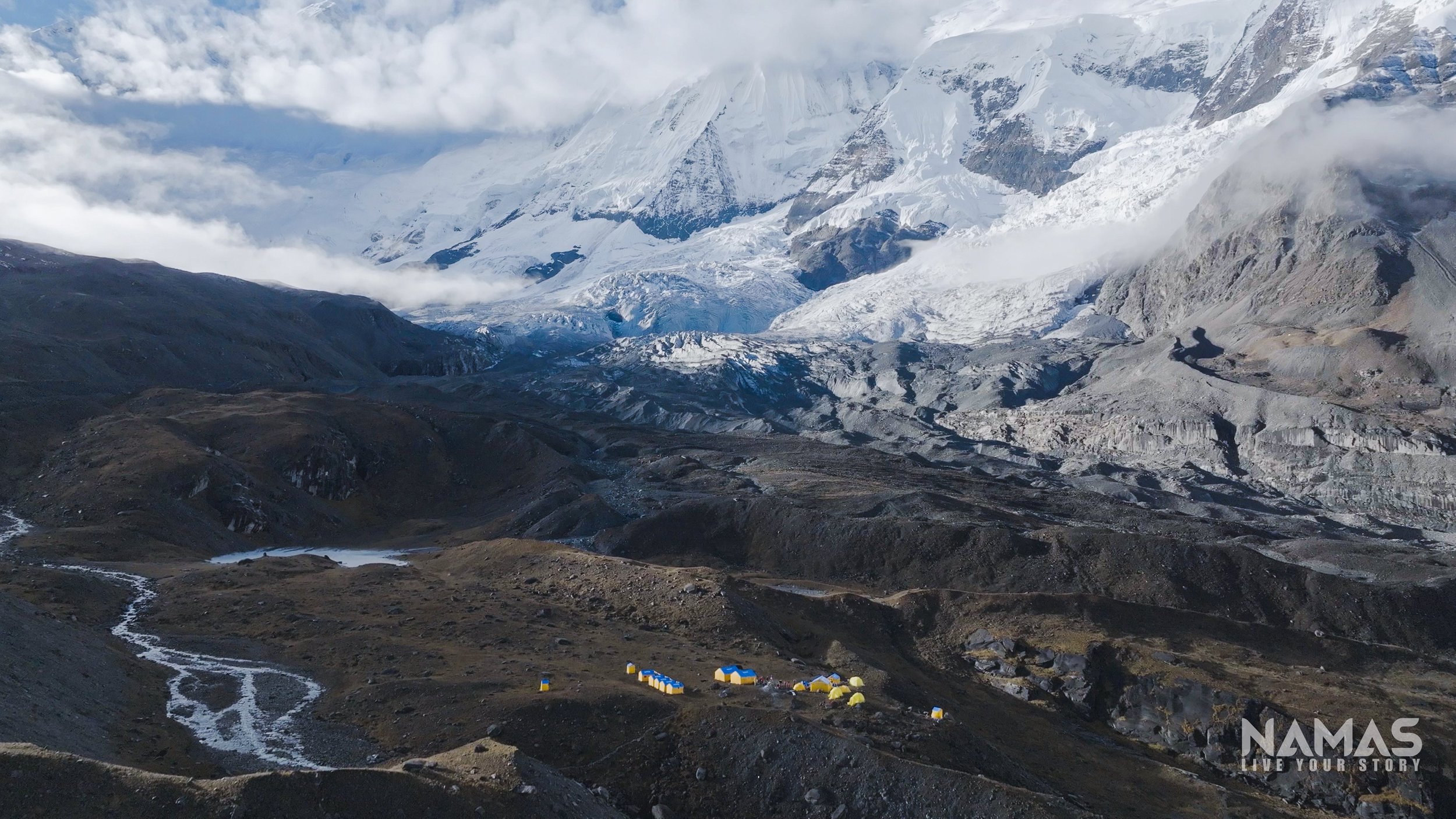
Annapurna 4, base camp
For climbers who want to test their real expertise before Everest, Annapurna IV (7,525 m) can be an ideal 7000 m mountain to climb. Annapurna IV provides greater altitude exposure while combining technical alpine terrain with fixed-rope climbing. Namas Adventure grades the mountain TD+/4 and recommends previous 6000m+ experience, including multiple high-altitude climbs and a strong alpine background. Climbing Annapurna IV during the autumn season offers premier climbing windows, stable weather, clear blue skies, and dry trail conditions.
Highlights:
Rarely climbed and accessible 7500M Peak with few objective dangers.
1:1 Climbing support
Small and dedicated team strategy. 3 to 10 max client members
Personal supplemental oxygen (1 cylinder and regulator)
Skip entry level 8000 m and get ready for Everest or another 8000 m peak
Camp 1, 2, 3 & 4 strategy. Heated dining tent, solo tent at base camp
Technical alpine climbing terrain
2. Himlung Himal (7,126M): Best for Your First 7000 m Expedition

Camp 1 at Himlung Himal expedition
During the autumn expedition, the mountain rewards you with stable weather, clear blue skies, and excellent mountain visibility. For climbers experiencing first 7000 m category peaks, Himlung Himal (7,126 m) is the best choice. The mountain follows a classic mountaineering style and is graded AD/4 by Namas Adventure, with gradual terrain compared with more technical 7000m peaks. The expedition uses multiple high-altitude camps, making climbers familiar with acclimatisation rotations, sleeping at altitude and managing effort over several days.
Highlights:
Accessible, classic mountaineering style and higher summit success rate
Small and dedicated team strategy. 1 to 8 max client members
1:1 Guide/Client support ratio during the expedition
The southern flank of the north-west ridge route, Camp 1 - 2 and 3 strategy
Nar and Phu Villages and Manaslu conservation area
3. Tilicho Peak (7,134M): Best for Technical Climbing Development
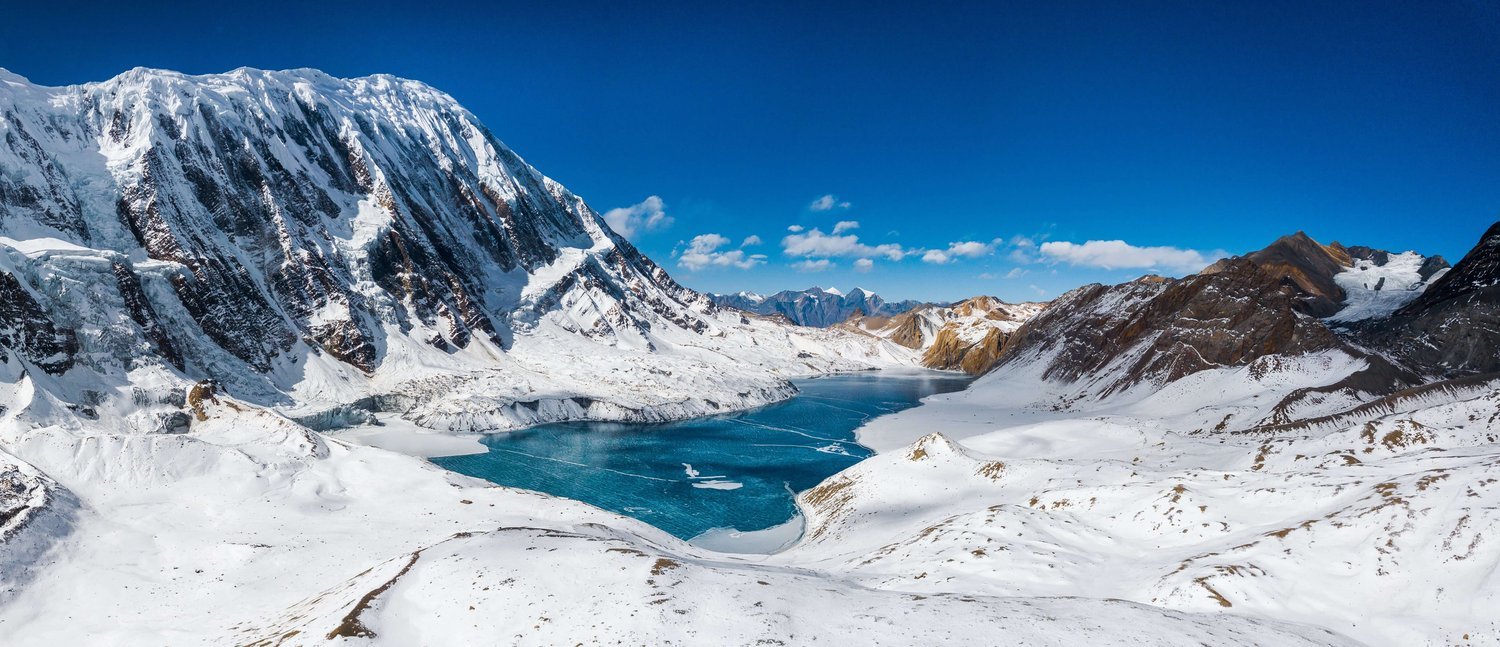
Tilicho Peak (7,134 m) can also be an ideal option for an autumn expedition to prepare for Everest. The autumn expedition to the Tilicho peak offers stable weather, clear blue skies, and dry climbing routes. This peak provides more technical climbing experience, where climbers involve steep ice and rock sections, and is graded D+/4 by Namas Adventure. Its Camp 1, 2 and 3 strategy gives climbers an opportunity to practise moving efficiently between high camps while managing technical terrain at altitude.
Highlights:
One of the more technical 7000 m peaks at intermediate grade
Part of the Annapurna massif
Small and dedicated team strategy. 3 to 10 max client members
North-West Shoulder Ridge route, Camp 1, 2, and 3 strategy
7 to 14 days in Tilicho Base Camp 4910M and higher
1:1 Guide/Client ratio throughout the expedition
Tilicho Lake at 4900 m, Annapurna 1, 2, 3, IV, and Gangapurna seen from the
4. Baruntse (7,129M): Best All-Round 7000m Preparation

Baruntse (7,129 m) offers a combination of altitude, movement in snow and mixed climbing experience. It is one of the ideal peaks for expedition during autumn, as the season offers crystal-clear visibility, firm snow, and stable weather after the monsoon season. Namas Adventure grades Baruntse AD+/4 and prepares for the summit through the southeast ridge with high-altitude camps. The mountain requires climbers to deal with snow ridges and mixed terrain while spending extended time at altitude.
Highlights:
1:1 Guide/Climber ratio during Summit Climb.
Southeast ridge route, Camp 1 to 2 strategy
Small and dedicated team strategy. 1 to 8 max client members
10 days in Baruntse Base Camp 5460 m and higher. Heated dining tent and single-person tent at base camp
Return via helicopter after the expedition
5. Putha Hiunchuli (7,246M): Best for Remote Expedition Experience

Putha Hiunchuli (7,246 m) is located in the remote Dolpo region of Nepal and is one of the best autumn 7,000 m expedition choices to prepare for the Everest summit. Autumn is the best time for Putha Hiunchuli, as the season welcomes climbers with clear skies, manageable cold, and stable weather in comparison to neighbouring peaks. The expedition to Putha Hiunchuli is a unique experience where climbers are required to move through glaciers, multiple high camps, and remote terrain in the Himalayas. This peak is graded as AD +/4 by Namas Expedition, as it involves gentler slopes and glacier travel.
Highlights:
Small and dedicated team strategy. 3 to 10 max client members
Northern Flaks, Camp 1, 2 and 3 strategy
10 to 12 days in Putha Hiunchuli Base camp and higher alpine camping
1:1 Guide/Client ratio throughout the expedition
Ski ratio 1:3 Guide to Client
Far West Nepal destination. Extremely remote, secluded, and pristinely beautiful DOLPO region.
6. Lakpa Ri (7,045M) (Note: While technically in Tibet, it’s often climbed as part of a Nepal-Tibet expedition)
Highlights:
Stunning views of Everest North Face
easier logistics
good entry-level peak
Alpine / Fitness grading: PD / 4 (non-technical snow climb)
Pre-requisite requirements (Ideal for first-time 7000m climbers with at least one or more 6000m summit.): Kilimanjaro, Mt. Elbrus, Lobuche East & Island Peak, Chulu West, Khumbu 3 Peak expeditions, Aconcagua, Mt, Blanc. (Similar 4000M - 6000M peaks or higher)
Which 7000m Peak Should You Choose Before Everest?
The right 7000 m peak for preparing for Everest depends upon the preference, goals, and experience people seek.
Choose Annapurna IV if you already have prior experience with the 6000 m peak and want a demanding technical challenge.
Choose Himlung Himal as your first 7000m expedition if your priority is altitude and acclimatisation experience.
Tilicho Peak can be ideal for you if you need to strengthen your technical climbing skills.
Baruntse can be an ideal peak for you if you want a balanced combination of altitude, snow and mixed climbing.
Choose Putha Hiunchuli if you want to do a remote expedition and gain experience in glacier travel.
When choosing 7000 m for preparing for Everest, choosing a peak just to meet the minimum altitude target cannot be the right decision. Instead, climbers must choose an expedition that exposes climbers to areas where they require experience and improvements.
Conclusion
An autumn 7000 m expedition is not just about meeting the requirement to summit Mount Everest. But the 7000 m expedition can be a valuable step climbers can take to get exposed to high altitude and technical terrains, acclimatised, and get familiar with challenging high-altitude weather conditions. And when choosing the 7000 m summit, the goal should not simply be to meet the requirement for Everest. But it should be to identify weaknesses, build high-altitude experience and become better prepared for the physical, technical and mental demands of Everest.Contact Namas Adventure today and prepare for the 7000 m peak expedition during autumn and fulfil your dream of standing at the top of the Everest summit.
