

Fixed Lines and Ladders, How They Help in High, Altitude Expeditions
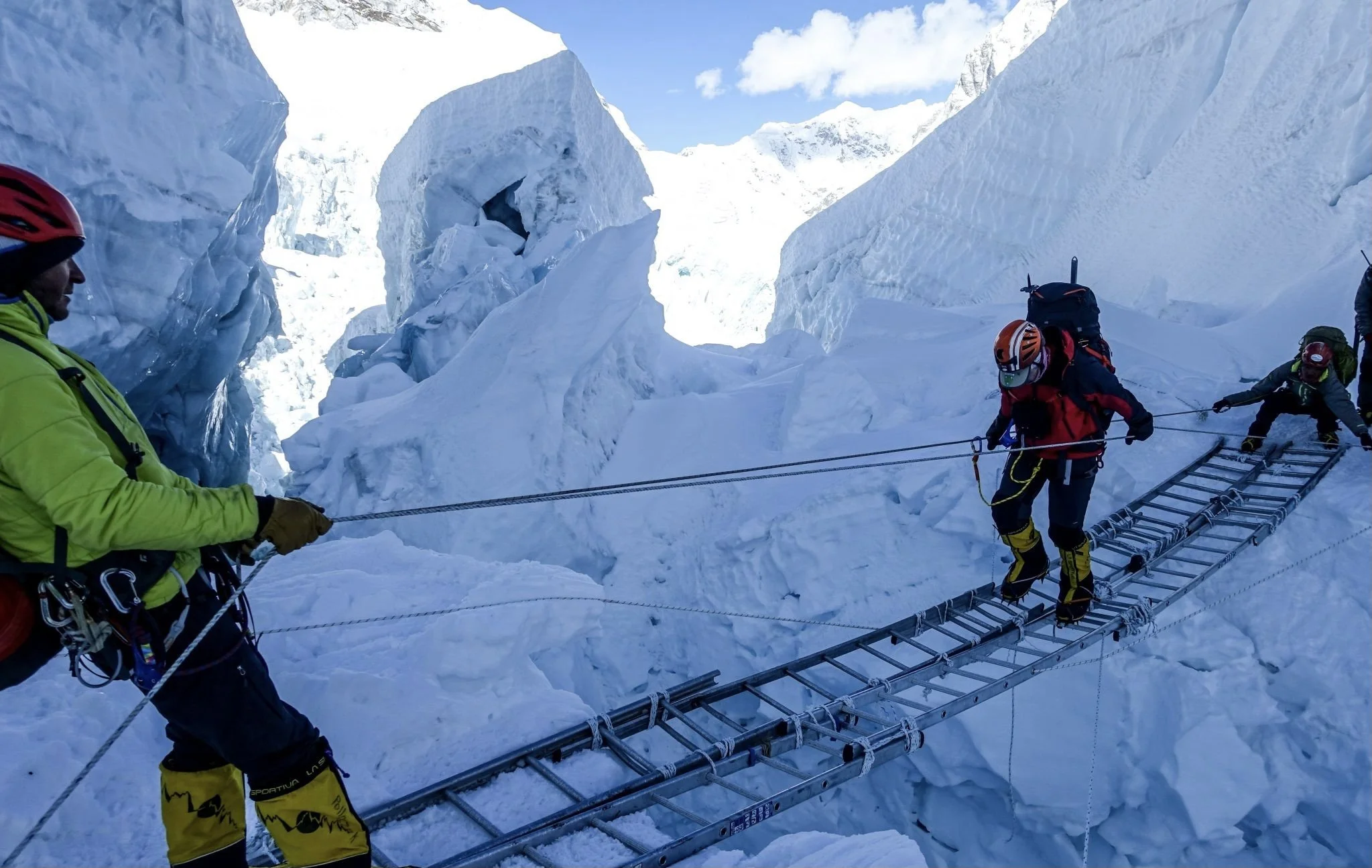
In high-altitude commercial mountain adventures, success is not just about the strength, technique, courage, and endurance of mountaineers. Commercial mountaineering success also depends on routes, which are managed through fixed lines and ladders by expert teams, making navigation safer and easier.
These setups help climbers get across challenging glaciers, crevasses, and navigate steep ice faces at higher altitudes. In areas where footing can be unreliable, crossing without fixed ropes and ladders increases the risk of falling. Fixed lines and ladders let climbers travel with more control through unstable surfaces. Behind every summit, these setups are carried out by experienced Sherpas, Ice Doctors(in Everest expedition), and rope-fixing teams before the climbing starts.
In this guide, we provide information about fixed lines and ladders, their importance in high-altitude expeditions, and how climbers use them to navigate high-altitude terrains.
What Are Fixed Lines and Ladders?
Fixed lines are strong multipitched climbing ropes that are anchored 25 m, 50 m, and 75 m apart along a climbing route, usually just for one season. These fixed ropes are used by climbers, who then clip themselves onto those ropes with safety gear like safety rope, ascenders, carabiners, and harnesses while they’re going up or down through steep terrain.
Meanwhile, ladders are lightweight aluminum steps set either horizontally or vertically across the deep, shifting glaciers and crevasses. They are used the most to cross deep crevasses, where the ice is unstable or not safe to step over on foot.
Both fixed lines and ladders make more secure passageways through the technically difficult and high-risk sections of a mountain.
Why Do Commercial High-Altitude Mountains Need Fixed Lines and Ladders?
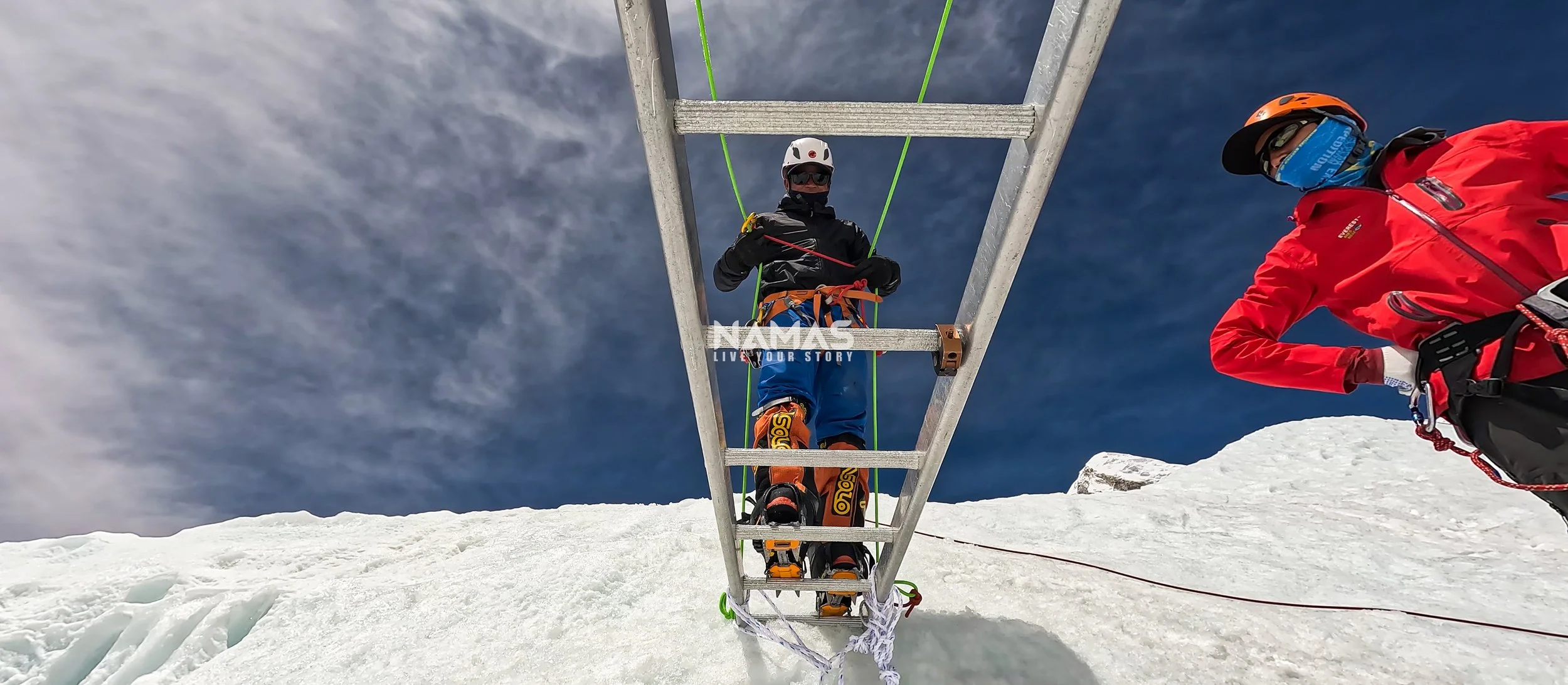
High-altitude mountains like Everest (8848.86 m) need fixed lines and ladder setups for success and minimizing accidents. It is because the routes in high-altitude mountains contain deep vertical cracks (glacial crevasses), vertical ice walls where climbing is not possible, and steep terrain. Navigating in these sections without rope and ladder support can be risky, as the chances of slipping and falling are high in such sections. Without the fixed rope and ladder, more commercial climbs are nearly impossible, as more than 80 to 90 % of climbers are not able to achieve their dream to conquer 7000 m and 8000m mountains, including Mount Everest.
Crossing Dangerous Crevasses
In expeditions like Mount Everest, sections such as the Khumbu Icefall feature deep, shifting cracks. Crossing such sections is impossible, as their gaps are wide and are very deep. To cross such gaps, expert teams set up ladders to bridge the gap. And to prevent falling while crossing the ladder, fixed ropes are installed to guide and support climbers.
Climbing Steep Ice and Snow Slopes
Steep Ice climbing sections and narrow but deep snows are common in many high-altitude mountains like Everest and K2. In these sections, ladders and fixed ropes are installed to allow climbers to cross the sections without risks. Climbers use ascenders by clipping them into fixed rope to move upward safely. Without ladders and fixed rope, crossing ice-climbing sections and narrow snow sections is risky.
Managing Traffic on Popular Peaks
In mountains like Everest, where traffic is high, fixed lines are often used to lead climbers to safe paths. The use of separate ropes is done during ascent and descent to prevent the climber from route deviation and confusion.
Who Sets The Fixed Lines and Ladders?
In major expeditions, fixed lines and ladders are set by highly experienced icefall doctors and elite guides within EOAN. Setting fixed lines and ladders required high experience, technical skills, and the ability to find a suitable spot and route for setup.
Early in the 2026 season, a large, unstable serac blocked the Khumbu Icefall route, forcing a near cancellation of the summit. These events stopped climbing for 1008 climbers at Base Camp, as key passages didn’t have secure fixed infrastructure. During the situation, fixed ropes and ladders were deciding factors to open the route safely during the season.
During the season, the leadership of Mingma G (Mingma Gyalje Sherpa) and 6 other highly qualified Sherpas, including Pemba Waiba, Dawa Tenzing, Saila Mingma, Dipen Gurung, Phuri Kitar, and Polish mountaineer Bartek Ziemski, dared to open the blockade by fixing ropes and ladders.
To open the blockade Ladders in the Khumbu areas were used to
Cross newly formed crevasses due to glacier movement
Bridge unstable and collapsed sections after serac obstruction
Reconnect the Everest route again after weeks of interruption.
Similarly, fixed ropes were used to
Allow climbers to climb steep segments more safely, particularly after those delays.
Reduce risk of delay during summit windows
Enabling quick movement at the opening of the route.
Icefall Doctor
Icefall doctors are highly expert specialists who inspect the terrain condition and ice structures and set up ladders across appropriate sections. They work in highly risky sectors such as the Khumbu Icefall on Everest and also secure fixed ropes to proceed ahead safely. During the entire climbing season, the Icefall doctors play an important role in checking the safety of the structure and route for safe passages of climbers. When repairs and adjustments of structure are required, they carry out repairs and rearrangements frequently in a season. In the Everest Expedition, Icefall Doctors set fixed lines and ladders in the Camp I and Camp II sections. These ladders are taken down at late May of 29 and 30.
Expedition Operators Association of Nepal (EOAN)
The Expedition operators Association of Nepal (EOAN) is the main body that plays an important role in organizing and coordinating rope-fixing teams in higher camps. EOAN deployed highly professional elite Sherpa guides to open routes and fix ropes before climbing season begins. These guides or highly experienced Sherpas risk their lives every season to anchor thick nylon ropes into high-altitude rocks and ice. These ropes act as safety lines for climbers ascending or descending from the summit.
In 6000m peaks like Island peak, Lobuche east, and Ama Dablam, EOAN takes responsibility for rope fixing and ladder setups. In mountains above 7000 m, the rope fixing is done by a team of elite guides through joint effort. In commercial expeditions, fixed lines and ladders are fixed by highly experienced Icefall doctors and EOAN. Meanwhile, in the Tibet region, the fixed line and ladder are coordinated by the China Tibet Mountaineering Association (CTMA) .
The 2026 Everest season showed how today’s Himalayan expeditions rely on the support and expertise of Ice doctors and rope-fixing Sherpas. Without their expertise, safe passage in the high-altitude mountains would not have been possible.
How Climbers Use Fixed Lines Safely
Climbers use the fixed line that elite guides and Ice doctors set earlier to safely pass the risky and difficult sectors. The use of fixed lines is done through connecting harnesses and safety carabiners.
During ascents, climbers use ascenders by sliding them upward along the rope for maximum safety. Similarly, during the descents, the climber uses a rappel device or belay for a controlled descent.
Conclusion
Fixed lines and ladders play an important role in making high-altitude expeditions safer and more successful. This setup helps climbers to cross dangerous crevasses, steep icy sections, and narrow surfaces with unstable surfaces safely. Expert ice doctors and elite guides who set up and manage fixed lines and ladders for climbers to pass the section safely. The incident of the 2026 Everest route blockage made it clear how ice doctors and the elite rope-fixing team played an important role in fixing ladders and fixed lines to reopen the route during the season.
If you are planning a high Himalayan expedition and want expert guides with safety and support, contact Namas Adventure. Namas Adventure provides prior training for improving your technical climbing skills, navigating skills to cross fixed ladders, and using fixed lines along with a personalized itinerary and guide to make your high Himalayan expedition memorable.
