

Hillary Step: What Really Happened To It After 2015?
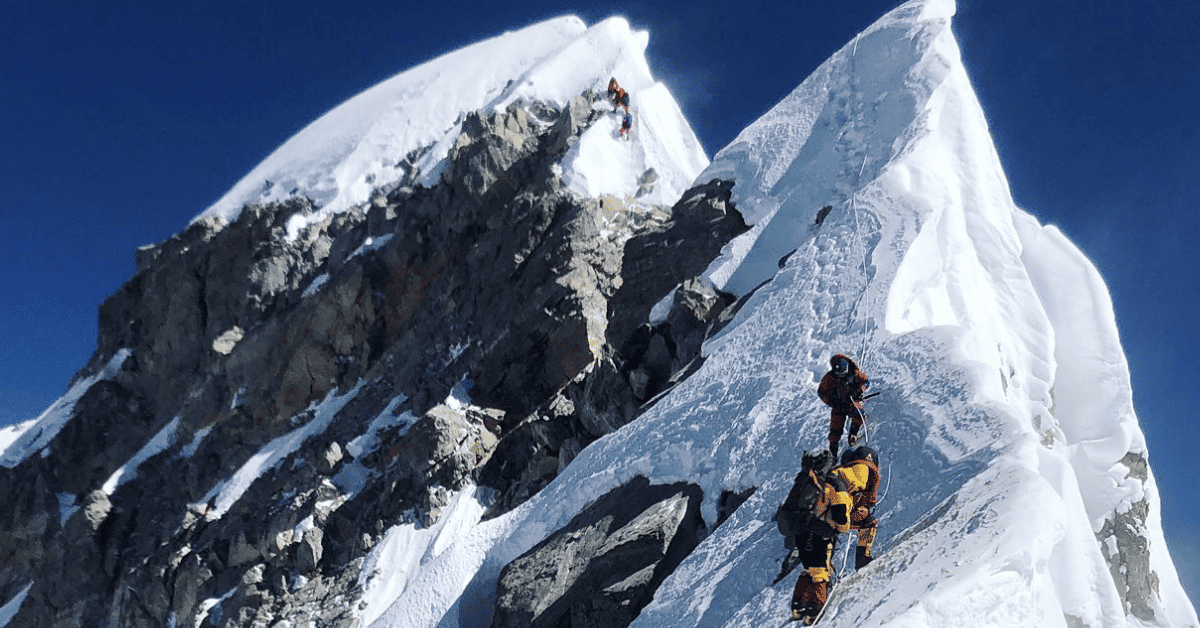
The Hillary Step, at an altitude of 8,790 m, is the 12 m vertical rock face at the southeast ridge of Mount Everest (8,848.86 m). This iconic landmark was named after Sir Edmund Hillary, who crossed it in 1953 along with Tenzing Norgay sherpa. This legendary location on the Everest summit ridge carries the legacy of being the final challenge to reach the top of the world. The Hillary step symbolizes human endurance, high-altitude challenges, and the pioneering spirit of mountaineering.
Hillary step is not only in the spotlight due to its legacy, as in recent days, it is also under debate due to its existence after the 2015 Earthquake in Nepal. Climbers who have reached the summit after the 2015 earthquake have reported about the change in structure of Hillary step. By 2017, many climbers claimed that the Hillary Step had disappeared dramatically. The debate circulated when Nepali guides and officials disagreed with the news, stating the vertical rockface was hidden under the snow and a small portion was visible. But what actually is the condition of Hillary Step now?
In this blog we try to take a closer look at facts regarding what Hillary Step was before 2015 and what it looks like today. The expert opinion about the changes in Hillary Step after the 2015 Nepal Earthquake and differing statements of climbers and Nepalese officials are also explored.
Hillary Step Overview
| Feature | Description |
|---|---|
| Location | Southeast Ridge on the final stretch of Mount Everest, between the South Summit and the true summit. |
| Altitude | 8,790 meters (28,839 ft) |
| Height | 12 meters (40 ft) |
| Structure | Approximately 12-meter vertical rock face. |
| First Climbed | 1953 by Sir Edmund Hillary and Tenzing Norgay. |
| Difficulty | Previously graded as Class IV/V technical climbing difficulty before 2015. |
| Current Status | Reported to have partially collapsed or become covered by snow following the 2015 Nepal earthquake. |
| Known For | The iconic final obstacle that tests the physical and mental endurance of climbers attempting to reach the summit of Mount Everest. |
A Historic Landmark In Everest Mountaineering
The Hillary Step is an iconic landmark that has been highlighted in global news and documentaries due to its historic significance. It was referred to as “The Step” Or “The Rock Buttress” previously, and as Sir Edmund Hillary navigated the section by wedging his body, performing a classic chimneying move, it became popular as the Hillary Step. It became a popular landmark in Everest as a major obstacle and also as a milestone that takes you close to the top of the world.
Location on Everest's Southeast Ridge
Hillary Step sits at the narrow southeast ridge on the final stretch between the South summit and the true summit of Everest. This rockface was popularly used as a navigational point that makes climbers realize they are close to the summit.
The Famous 12-Metre Rock Face
Before 2015, the Hillary Step was a clearly visible 12m rock face that stood in the summit route as a final challenge to the climbers. This was a technical obstacle that required climbers to use fixed ropes to ascend and cross it. The section queues climbers, causing a bottleneck and exposing climbers to the harsh conditions of the Everest death zone.
The Hillary Step Before 2015
The Hillary Step before 2015 was a near-vertical 12 meter rockface located around 60 m below the top of Everest. The section had major challenges at the death zone that required technical climbing and crampon skills, where climbers maneuver through narrow cracks. The section accommodates one climber at a time, which led to a significant traffic jam.
What Climbers Experienced at the Step
As mentioned above, climbers experience long traffic jams due to bottlenecks at the sections. The narrow section just below 60 m of the summit requires careful movement, strength, and endurance. The long congestion in the section requires climbers to face long holds at dead zones, which significantly increase the risk of summit delays and changing weather.
Did the 2015 Nepal Earthquake Change the Hillary Step?
The 2015 Gorkha earthquake of Nepal triggered avalanches and led to landscape change in the region. Climbers returning after the Everest summit reported about the disappearance of Hillary step. Many reported that the Hillary Step has partially gone or gotten covered under the snow surface.
The section with a vertical 12m rock face was replaced by a steep and 45 to 60° inclined ice and snow slope. Climbers report that the changes after the earthquake have comparatively made the sections easier to navigate. Although the section still challenges climbers with various risks and challenges like unstable footing and avalanche.
The 2017 Controversy: Was the Hillary Step Gone?
The year 2017 highlighted the changes in Hillary Step after the devastating earthquake of 2015 in Nepal. As the matter was on global news platforms, many guides and officials denied the fact, making the news controversial.
Claims from climbers
Many mountaineers and well-known expedition leaders have expressed that the iconic Hillary Step is now replaced by a snow slope. The British mountaineer Tim Mosedale, who reached the summit on 16 May 2017 for the 6th time, released recent photographs of the section where the steep rock sections were not clearly visible. The 6th-time Everest climber expressed his opinion that the section might have been destroyed by the 2015 earthquake.
Another British mountaineer, Kenton Cool, also released the picture of the step that he took in May 2016 where the Hillary Step was not clearly visible. The climber supports the statement of Tim Mosedale, saying the step does not look like it did a few years ago.
Similarly, the American climbers Garrett Madison and Ben Jones also confirmed that the iconic rock is replaced by a steep snowy slope with an incline of 45 to 60°.
Disagreement from Nepalese Official and Guide
As the news and photographs of climbers were circulated online, the Nepalese official and local guide expressed that the Hillary step has not disappeared entirely. An experienced high-altitude guide, Pasang Tenzing Sherpa, after returning from the Everest summit, stated that the step is intact. Supporting the statement of Pasang, the president of the Nepal Mountaineering Association, Ang Tshering Sherpa stated nothing has happened to the Hillary Step. He stated that a small portion of rock is visible and the rest of the sections are covered in snow.
Evidence Supporting Both Sides
The statement of the Nepalese official and guide got into a debate as different accounts from climbers and photographic comparisons of the Hillary Step before 2015 and after 2015 led the matter to complexity.
While the photographic comparison shows noticeable changes in the ridgeline, many still believe that the difference was due to the rock face being hidden under the snow.
What Do Most Experts Believe Today?
While the majority of climbers accepted the changes in the Hillary step being altered after the 2015 earthquake, no scientific confirmation or measurement was taken. The photographic comparison clearly suggests the changes of the structure, but the evidence itself is not sufficient. As the conditions of the Everest landscape are not constant and change frequently, due to which no exact conclusion can be drawn without proper investigation.
Conclusion
The Hillary Step on the Southeast ridge on the final stretch of Mount Everest is the historic landmark popular as a navigational point, the final challenge, and the historic step of legendary mountaineer Edmund Hillary. But recently the change in its structure after the 2015 earthquake has also made the step a popular and much-debated topic. While climbers climbing after 2015 notice the disappearance of the step and presence of a 45 to 65° elevation step, the local authorities and guides state the iconic landmark is still on Everest but appears different as it is covered by snow.
The fact of changes in Hillary Step before and after the 2015 earthquake can be the matter of scientific investigation to know the exact reality. But if the iconic landmark of Hillary step is altered or has collapsed, it entirely changes the experience of mountaineers and the way it is remembered in history. The legacy it carried, being recognized as a technically challenging test just before the summit, will just be limited to the story.
If you are inspired by the history, challenges, and experience of the iconic sections of Everest by yourself, visit Namas Adventure. Namas Adventure provides guided treks, expeditions, and expedition training with proper itineraries and customized plans to ensure your Himalayan expedition is successful and safe
