

Icefall Doctor - The Unsung Heroes of Everest’s Khumbu Icefall
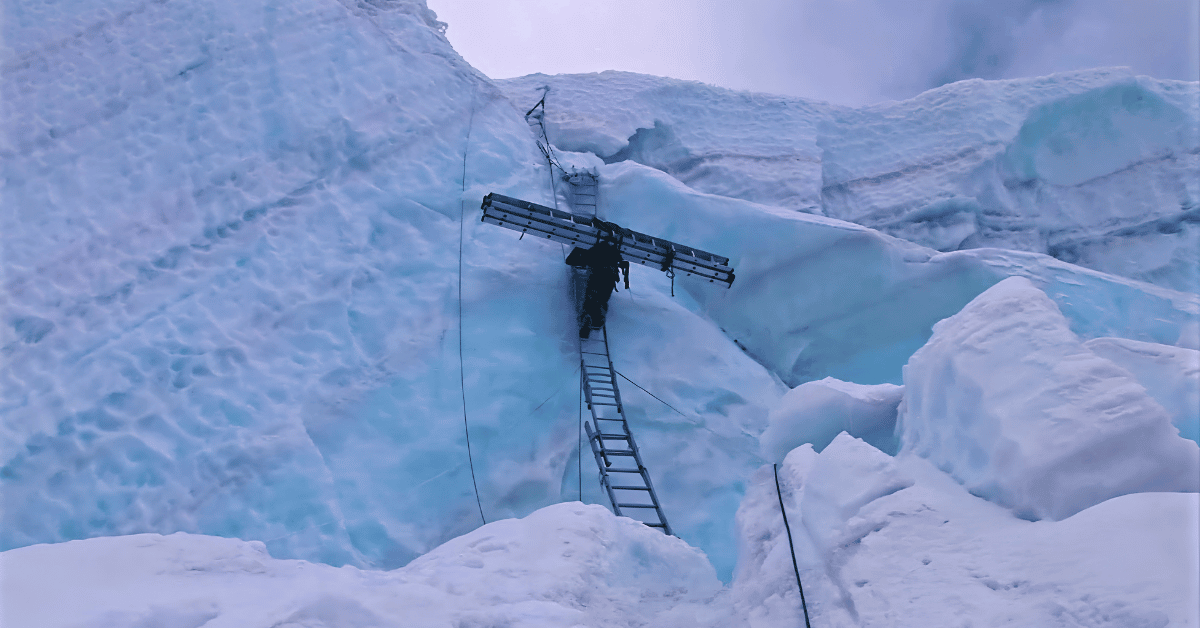
When you think about Everest, you associate it with summit climbers, record holders, and extraordinary achievements of climbers. But very few people know about Icefall Doctors who work hard to make those climbs and record-keeping possible.
Icefall doctors are highly experienced and skilled Sherpas who have specialization in creating and maintaining the Everest summit route. They navigate the route, maintain route conditions, set up ladders and ropes, and operate under the umbrella of the Sagarmatha Pollution Control Committee (SPCC). Everest expeditions at a commercial level are possible due to the contribution of Icefall doctors in maintaining and fixing the ladder or route to reach Everest, Lhotse, and Nuptse.
The role of Icefall doctors is not highlighted as much as the achievements of mountaineers or climbers in Everest, but they are surely the reason that leads climbers to grab such achievements. In this blog, we explain who Icefall doctors are and their roles in mountain expeditions. Their way of working to prepare the route for Everest, daily routine, and role during the 2026 Everest route blockade incident are also explained.
Who Is an Icefall Doctor?
Icefall doctors are highly professional and experienced specialists who have knowledge regarding the terrain conditions, ice structures, and route selection during high Himalayan expeditions like Mount Everest's. They have deep knowledge of glacier terrain and ice structures and are appointed by the Sagarmatha Pollution Control Committee (SPCC) in Everest. The team of Icefall doctors normally consists of 8 to 11 Legendary and veteran Sherpas. Their responsibilities include the following:
Scouting routes: Icefall doctors search for the safe route to ensure they choose ideal spots for safe passage
Safety ropes and ladders: They secure fixed and specialized lightweight aluminum ladders over crevasses and set up nylon safety lines by placing anchors in shifting ice
Regular maintenance: Icefall doctors carry out regular maintenance activities following inspection and repairs over constantly shifting ice sections.
Garbage Management: Being under SPCC, Icefall doctors also take care of the environment by assisting in monitoring and bringing excess garbage in the Everest region.
Icefall doctors set up ladders on the early day of March to prepare for April summit season. Meanwhile, they take out ladders at the end of May.
How Icefall Doctors Prepare The Everest Route
Icefall doctors carry out intensive preparation by organizing traditional Puja ceremonies at Everest Base Camp and polish their navigation ability through training at Khumbu Climbing Center. Following the training and traditional ceremonies, they begin their journey to prepare the Everest route, which includes the following:
Scouting the path: Icefall doctors search for the best routes or paths that are safe and stable for installing ladder bridges and safe navigation
Ladder setup: After careful selection of an ideal spot, they set up the bridge by securing multiple aluminum ladders with anchors and screwing it into ice.
Rope fixing: Icefall doctors also install fixed ropes in the route so that climbers can clip their harnesses to the rope to navigate safely.
Repair: The Icefall doctors also fix or repair ladder paths daily at regular intervals to ensure they are safe and don't collapse.
Dismantling: Once the climbing season concludes, they remove the installed ladder and other equipment to prevent environmental hazards.
Daily Routine Of An Icefall Doctor
The daily routine of an Icefall doctor includes inspection of the ice structure, repairing or adjusting the ladder bridge, and clearing risk caused by collapse of the ice structure in areas like Khumbu Icefall. Their key daily responsibilities involve checking the need for emergency repairs and ensuring the route is safe from Base Camp to Camp 2.
Early Morning Inspection
The day of Icefall doctors starts with inspection of the route and overnight ice movement. They must look for new formations of crevasses and unstable snow bridges. Following the inspection, they decide whether the route is safe or requires repairs.
Route Monitoring
Following inspection in the morning, they continue to check glacier movement and check for structural instability. They track high-risk areas and ensure fixed ladders and ropes are stable.
Repair Work
Following the route inspections, the Ice doctors immediately start repair works if icefall collapses or shifts. They check the integrity of the ladder and replace it for safe passage. They also rebuild damaged route sections by strengthening anchors and fixing ropes.
Coordination with Expedition Teams
Icefall doctors not only work on repairs and fixing the routes, but they also work by coordinating with expedition teams. They share updates about the route condition, advise climbers regarding safety, and coordinate logistics in narrow sections.
Role of Icefall Doctors in the 2026 Everest Route Blockage
The Spring climbing season of 2026 experienced route blockage in the Khumbu Icefall, leading to near summit cancellation. The blockade was caused by the 100ft tall and unstable serac on the route to the only passageway below camp I. This blockade impacted and halted the Everest summit of more than 1,008 climbers, as it is not possible to cross the Khumbu Icefall route without fixed infrastructure. And to reopen the closed route, the Icefall doctors played a crucial role. Their role in reopening the blockage is provided below:
Risk assessment and survey
As the route was blocked, the Sagarmatha Pollution Control Committee (SPCC) deployed elite Icefall doctors to manage and find out the route through the Khumbu Icefall. They assessed the condition of the route and halted route-fixing work to avoid an avalanche. The use of drones was done to monitor the condition of shifting glaciers and hanging ice walls in the area. They collaborated with expert guides from the Expedition Operators Association of Nepal (EOAN) to find a suitable and safe passageway following safety protocol.
Reopening the Route for Climbers
After nearly 2 weeks, the eight Icefall Doctors and 17 expert mountain guides cleared the bottleneck. As the condition stabilized, the Icefall doctors installed aluminum ladders in newly formed crevasses to bridge unstable gaps. They also secured nylon ropes to ensure safe passage from the risky sections. This helped to reconnect the Everest route and continue the commercial expedition for the season.
Risks Faced by Icefall Doctors
The work of Icefall Doctors is risky, as it requires working in a hazardous environment. The elite Sherpa professional works in shifting glaciers, collapsing seracs, and avalanches to fix ladders and ropes. They risk their lives to ensure safe passage of mountaineers from sections. Some of the key risks faced by Icefall Doctors includes:
Risk of life-threatening accidents while working in the sections where the chance of massive serac collapse is high.
Risk of falling in the hidden and deep crevasses during ladder and rope fixing works
Risk of being trapped in avalanche that triggers without warning
Icefall doctors face severe risks of Acute Mountain Sickness (AMS) as they are required to operate in a cold and high-altitude environment
Icefall Doctors Team
The Icefall Doctors are selected and deployed every year by the Sagarmatha Pollution Control Committee (SPCC) according to expected needs, experience, and fitness level. The core team in 2026 is led by veteran Sherpas Ang Sarki Sherpa and Dawa Jangbu Sherpa. Other notable names with high experience in the section include:
Tendu Sherpa
Ngima Tenji Sherpa
Phura Chheten Sherpa
Dawa Chhiring Sherpa
Sonam Geljen Sherpa
Mingma Gyalzen Sherpa
Conclusion
Icefall doctors working in the high-altitude Himalayas are pillars that ensure the safe expedition of every mountaineer. While climbers are recognized for their achievement and record they achieved, these Sherpa specialists risk their lives daily to create safe and secure passage for climbers. Their courage and technical skill make high-altitude mountaineering accessible.
Namas Adventure deeply respects the Icefall doctors and their contribution in making Himalayan expeditions safe. Explore Everest and Himalayan expeditions with Namas Adventure and experience how expert Icefall doctors pave the path to help you cross the challenging sections
