

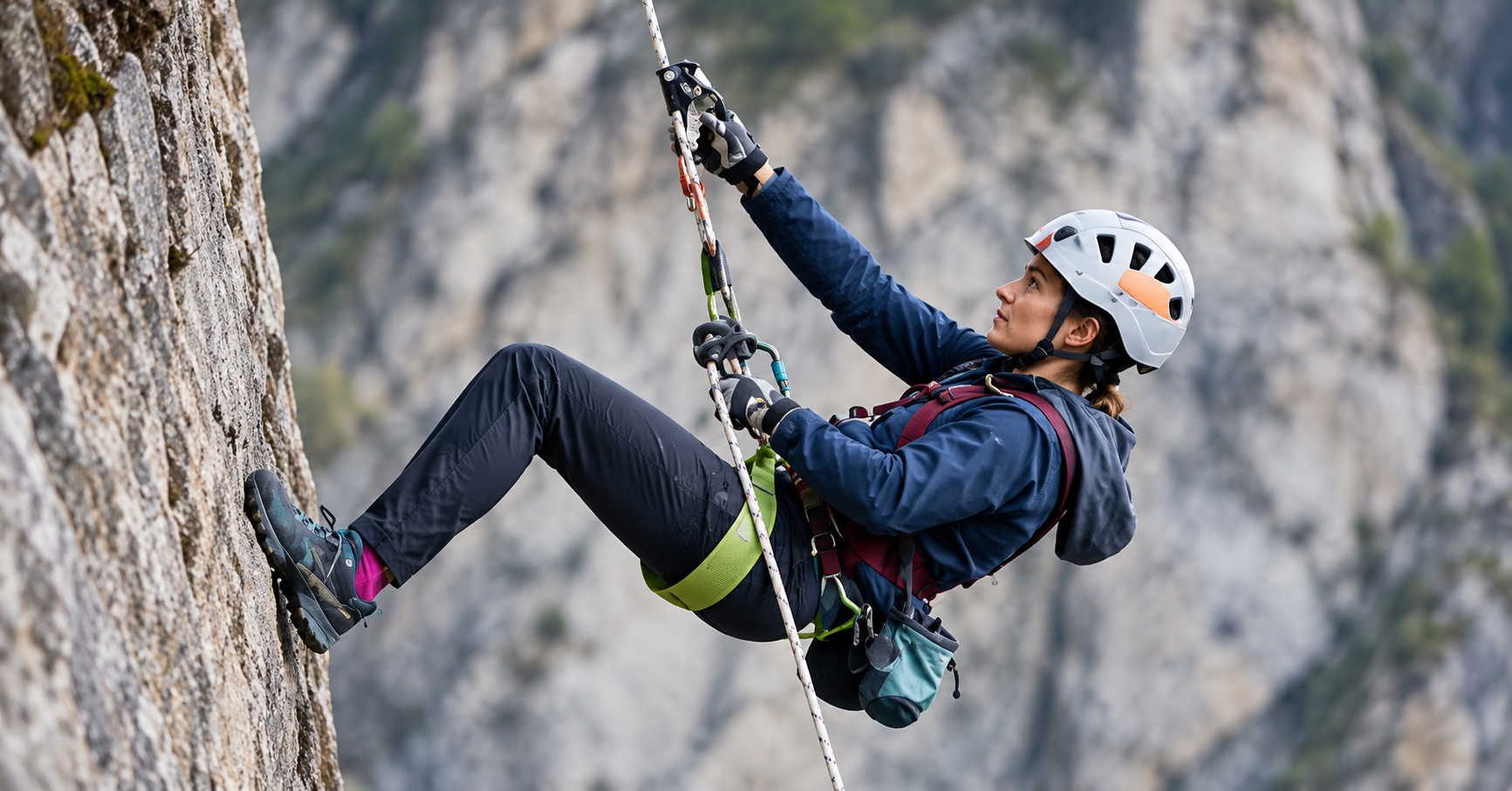
The technical mountaineering skills, physical endurance, and knowledge of effective use of mountaineering equipment are required for climbing a 7000m mountain. Fixed ropes and specific climbing equipment are commonly used by climbers on steep snow slopes, high-altitude routes, and other difficult areas to assist with climbing and descending. The Jumar (ascender) and ATC belay device are two of the most important items of fixed-line climbing equipment used during an expedition.
A Jumar is climbing and mountaineering equipment which helps climbers to climb a fixed rope, and an ATC is a friction-based climbing equipment used to belay and descend in a controlled manner. They both need correct techniques and fitting equipment and experience to use safely.
In this blog, we explore what Jumar and ATC devices are, including their working mechanism, their usage during the 7000m expedition, and important safety principles climbers need to be aware of before tackling high-altitude routes.
What Are Fixed Lines, and Why Are They Used on 7000m Peaks?
Fixed lines are ropes anchored along a chosen section of a mountain route to which a climber can attach himself. They are normally placed by expert rope-fixing teams and Sherpas to aid the climbers in navigating steep snow, hard icy terrain, and exposed ridges. Fixed ropes offer a solid anchor line for climbers to use, and they enable them to use the right equipment to climb or descend on a difficult section.
Fixed ropes may be used in difficult areas on the route or based on climbing strategy on 7000 m expeditions such as Himlung Himal (7126 m), Tilicho Peak (7134 m), and Annapurna IV (7525 m). According to the requirements, climbers use the required equipment for this activity: ascenders, safety connection and descent systems. But even with fixed ropes, the dangers of falls, anchor failure, avalanche and equipment damage remain.
What Is a Jumar (Ascender) and How Does It Work?
A Jumar is a mechanical rope ascender designed to help climbers move upwards along a compatible climbing rope. The Jumar was originally a brand name, but the term is often used to refer to ascenders with handles. They typically consist of a handle, a toothed cam system, a locking mechanism and attachment points for additional climbing gear.
The ascender is designed to slide up the rope in one direction and hold when loaded in the other by means of the internal cam.
How Do Climbers Use a Jumar on Fixed Ropes?
As climbers attach to a fixed rope, they use a Jumar to help their ascent along the rope. The ascender is usually attached to a climbing system that includes a harness and other suitable connections and, in most cases, a foot loop. On more difficult sections these components will aid the climber in controlling his or her climbing technique and keep the safety measures called for by the guide.
It is not enough to attach a Jumar to a rope to use it. Climbers need to be aware of how the cam operates and how it should be loaded, as well as avoiding any conditions that might lead to slipping or to shock loading. The correct attachment and movement technique is learned by supervised practical training.
When Is a Jumar Used During a 7000m Expedition?
Jumars are often used on steep fixed rope sections on ascents between camps and on some summit routes. They can be helpful if climbers are faced with hard snow, icy slopes and open areas where ascending using rope is necessary.
An ascender will be required depending on the mountain, route and conditions. Fixed ropes may be climbed in some sections without an ascender (crampons), and in steeper passages a different method is used. The decision of what equipment and climbing techniques to use is decided by the expedition leaders.
What Is an ATC Belay Device and What Does It Do?
The ATC belay device is a friction-based climbing device that is used for belaying and rappelling during mountaineering. Due to its metal construction, it will create friction if used with an appropriate rope and carabiner setup. When a climber falls, the belayer pulls the brake strand of the rope downward to pinch it and stop the descent.
The ATC belay device allows the belayer to smoothly take in rope and lower the climber in a controlled way. Climbers use these devices to manage their descent in a controlled way during rope abseils.
How Is an ATC Used for Descending Fixed Ropes?
During a rappel, an ATC generates friction to help regulate descent by a trained climber. It is used as part of a descent system that is properly set up, with appropriate anchors, compatible ropes, carabiners and any necessary backup arrangements. The climber has to keep the brakes on during descent.
But not all fixed ropes can be rappelled with an ATC. This method is appropriate depending on the construction, thickness, condition, anchor setup, and procedures of the rope used, including the conditions of the expedition. Never try a descent setup that you are unfamiliar with without the guidance of a certified instructor or guide.
When Is an ATC Used During a 7000 m Expedition?
ATC belay devices are used during controlled rappels on appropriate technical sections, to descend a climbing pitch and for belaying. The common use of ATC during the 7000 m expedition is explained below:
Rappelling (Abseiling): When descending from fixed lines, steep ice walls, or rock bands, an ATC is used to control the speed of descent. These are mostly used when descending with a Jumar is not possible.
Partner belaying: When the team encounters a crevasse field, rock or ice step, or short pitch requiring safe lead or top-rope belaying, ATC devices are used.
Guide Mode / Reversible Belay: ATC belay devices like Black Diamond ATC Guide or Petzl Reverso can be attached to an anchor to pull up slack and automatically block second climbers in case they fall.
Rope Backup & Rescue: In technical ridges, if climbers get injured or stuck, using a Prusik backup loop, you can tie off the loaded rope coming out from ATC and transfer the weight of climbers directly to the anchor and safely detach from the system for rescue.
Jumar vs ATC: What Are the Main Differences?
Jumar and ATC devices are important mountaineering equipment with different purposes. Climbers must understand their function and uses to recognise appropriate use during ascent, descent, and technical rope work.
| Features | Jumar (Ascender) | ATC Belay Device |
|---|---|---|
| Primary Function | Assists upward rope travel | Belaying and rappelling |
| Working Mechanism | Mechanical gripping cam | Rope friction |
| Typical Application | Ascending fixed ropes | Controlled descents and belaying |
| Main Components | Handle, cam, safety catch, and attachment points | Metal body, rope channels, and retaining cable |
| Important Limitation | Not a substitute for a fall-arrest system | Requires active braking control during normal rappelling |
What Other Equipment Is Required with a Jumar and ATC?
You can't use a Jumar and an ATC alone, as they are components of two different systems, ascending and descending, which need a set of fundamental climbing gear components to link to the climber and the rope. The essential equipment needed to make them functional are provided below:
Mountaineering harness: Provides suitable attachment points for climbing systems.
Secure carabiners: Attach compatible equipment into the permitted rope package.
Safety lanyards: Be used as part of the climber's connection system as needed. In the case of a handled ascender, they may provide some assistance in moving with the foot loop.
Climbing helmet: Protects from impacts and falling objects.
Prusik Loop / Third Hand: A short piece of 5 mm to 6 mm accessory cord or mechanical backup (such as a Petzl Shunt). A safety precaution below the ATC on the brake strand is a friction hitch (such as an Autoblock or a Prusik) in case you slip off the rope.
Extension Sling: 60cm or 120cm webbing sling to lengthen the ATC to reduce the need to handle it in conjunction with the backup hitch.
Static or Dynamic Climbing Rope: The system will be of no use if it isn't equipped with the proper diameter rope (usually 9 mm - 11 mm) that is suitable for the type and weight of climbing you are engaged in.
The type of equipment should correspond to the type of rope and expedition. The climber should ensure compatibility and configurations with the guides, without assuming everything is compatible.
Essential Safety Principles for Using Jumar and ATC on Fixed Ropes
Redundancy of equipment, correct orientation and disciplined use of ropes is your only safety when moving up or down a fixed line. Going up with a Jumar (ascender) and coming down with an ATC will need different safety measures to avoid catastrophic failure.
The essential safety principles for both devices when using them on fixed ropes include:
Check Equipment and Rope Compatibility
Check the Jumar, ATC, harness, carabiners and ropes for damage, excessive wear or malfunction before climbing. Determine the manufacturer's recommended rope size and application specifications since the size of the rope will vary according to the type of equipment being used. Frozen, wet or damaged ropes can also have an impact on the performance and should be carefully considered.
Maintain Proper Safety Connections
Climbers need to be aware of the need for good safety connections, backup systems and not using the ascender in an unsafe manner. Close attention must be paid to anchors and transitioning between sections of rope, as improper movements can create fall hazards. These procedures need to be conducted in a supervised manner and should not be known completely through written instructions.
Follow Professional Guides and Established Procedures
Climbers should follow their expedition leader's instructions for fixed-line movement, rope systems, equipment checks, and communications. On narrow or exposed areas, where rope may be crossing other climbers, it's important to remain aware of other climbers. Climbers should halt if a rope, anchor or device looks unsafe and ask for advice before proceeding.
How to Prepare for Fixed Rope Climbing Before a 7000m Expedition?
To prepare for a 7000m expedition, one needs to be physically fit and have required rope skills. Climbers must be trained in the safety, techniques and procedures of jumaring, rappelling, belaying, checking fixed rope and equipment, and managing fixed-rope systems. There should be supervised practice with the equipment and techniques that will be used during the expedition.
Both mountaineering boots, crampons and insulated gloves can also impact how you move and handle your equipment, so practice is important considering those factors. It is essential for climbers to build this confidence before heading up to high altitude by being able to identify equipment issues and respond to emergencies.
Conclusion
The Jumars and ATC belay devices are used in mountaineering for different but important purposes. A Jumar helps climbers on fixed ropes, and an ATC belay device supports belaying and controlled rappelling on appropriate rope systems. Before continuing a 7000m journey, it is important to be familiar with their functions, equipment compatibility and safety requirements.
If you are planning for a 7000 m expedition with full preparation and training to use fixed ropes and specific climbing equipment like Jumar and ATC belay devices, contact Namas Adventure. Namas Adventure provides expert guidance, mountaineering training, and advice on choosing gear to ensure your expedition is safe and successful.
