

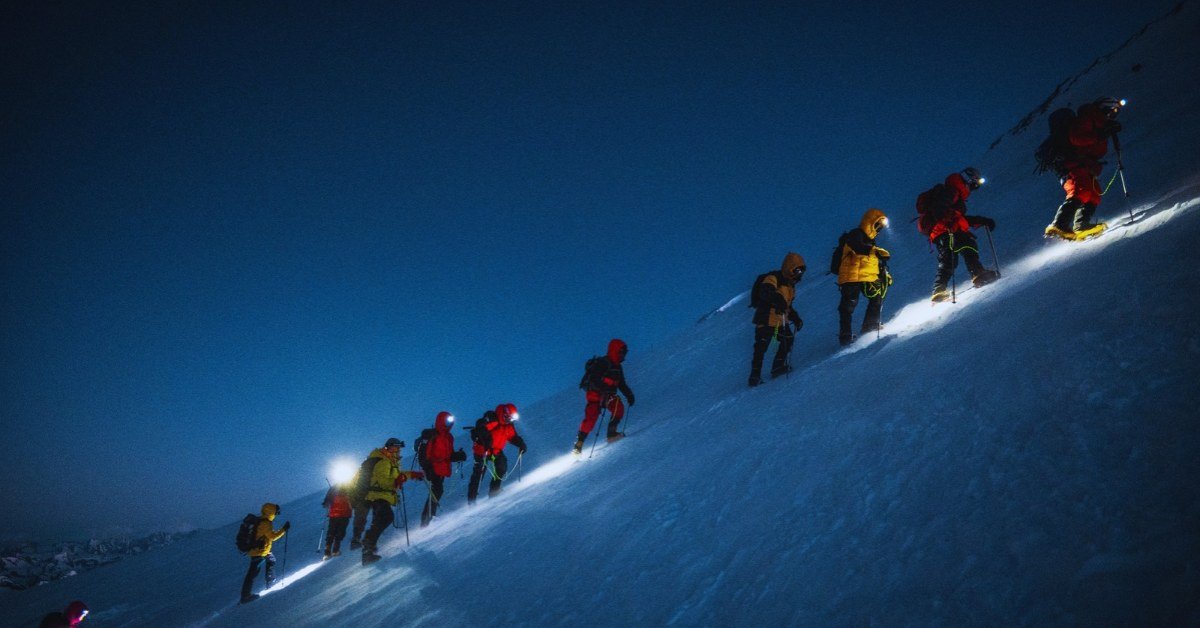
In most high-altitude mountaineering expeditions, the summit push starts before sunrise. Climbers leave high camps during the dark in freezing temperatures, often wearing thick mittens, and depend on their headlamps to navigate. A reliable headlamp is important in high-altitude mountaineering, as it provides clear sight in the dark while navigating in snow, fixed ropes, anchors, and the track ahead while keeping both hands free for an ice axe or ascender.
But which headlamp for mountaineering is suitable for these conditions? Headlamps for high altitude mountaineering are designed to perform during extreme cold and weather conditions. The high altitude and extreme cold degrade performance, and the buttons in headlamps may be difficult to operate.
In this blog, we provide information about the best headlamps for summit night, which helps climbers navigate safely in the dark. The features to check, suitable headlamps, and practical tips for summit-night preparations are also provided.
Why Is a Reliable Headlamp Important for Summit Night?
A reliable headlamp carries great importance on summit night, as it involves several hours of climbing during the dark. On the steep, icy, rocky, and rocky terrain or while crossing through fixed-roped sections, climbers need artificial light to place their feet, attach carabiners, and progress towards the summit. In such a situation, if a headlamp stops working, it can cause serious problems, which include stepping in wrong or risky sections, delays in summit push, and exposure to extreme altitude and temperature while waiting for assistance.
Headlamps are also important gear that helps climbers with lights during unexpected delays and poor visibility. The various light modes of the headlamp can be used according to condition and situations at high altitude.
Key Features to Look for in a Mountaineering Headlamp
When purchasing or selecting the mountaineering headlamp, one must consider its key features, which include the brightness and lumens, battery, beam patterns, cold weather performance, durability and weather resistance ability, control, and ergonomics.
| Feature | What to Look For | Why It Matters |
|---|---|---|
| Brightness and Runtime | A useful medium setting with sufficient burn time and high output when needed. | Helps you see the route without exhausting battery power too early. |
| Beam Pattern | A wide beam with a focused or mixed beam option. | Illuminates nearby footholds and more distant route markers. |
| Battery System | Replaceable batteries or compatible backup power. | Makes it easier to recover from power loss. |
| Cold-Weather Setup | Lithium batteries and a remote battery option where available. | Helps maintain battery performance in freezing temperatures. |
| Weather Resistance | IPX4 splash resistance or stronger protection, such as IP67. | Reduces exposure to snow and moisture. |
| Controls | Lock mode and buttons that are easy to operate with mittens. | Avoids accidental switching and fumbling on exposed ground. |
| Helmet Fit | Secure strap, clips, and adjustable lamp angle. | Prevents the light from slipping during movement. |
If you are planning for a long summit push, compare the manufacturer's medium-mode runtime.
Best Headlamps for Mountaineering and Summit Night
The best headlamps for mountaineering and summit pushes balance high output brightness, glove-friendly control, battery backup, weather-resilient battery, and reliable IPX/IP68 weatherproofing. In the table below, we provide information about some of the best headlamp models for long summit pushes and high-altitude mountaineering:
| Headlamp | Specifications | Why Consider It |
|---|---|---|
| Petzl ACTIK CORE | 625 lumens, a CORE rechargeable battery or three AAA cells, and an IPX4 rating. | Hybrid power is practical when you want a second battery option. Useful for approaches and as a backup lamp. |
| Black Diamond Storm 500-R | 500 lumens, integrated 2,400 mAh rechargeable battery, and IP67 rating. | Sealed housing and proximity/distance lighting, but the battery is not interchangeable. |
| Petzl SWIFT RL | 1,200 lumens, 2,250 mAh rechargeable battery, and IPX4 rating. | Reactive lighting adjusts output automatically. Suitable for climbers wanting a compact, powerful beam. |
| Black Diamond Spot 400 | 400 lumens; three AAA cells or a compatible BD 1500 rechargeable pack; IPX8 rating. | Dual-fuel option for approaches, lower-altitude climbing, or backup use. |
| Petzl NAO RL | 1,500 lumens, 3,200 mAh rechargeable battery, and IPX4 rating. | The optional R1 extension cord allows the battery to be carried inside a warm jacket pocket. |
For extremely cold summit nights, climbers must consider a headlamp with a remote battery system. NAMAS Adventure also recommends a separate head torch with a remote battery system for night climbing in its mountaineering equipment checklist.
Headlamp Battery Performance in Extreme Cold
Cold temperatures affect battery efficiency, which makes battery management important during long summit pushes. The batteries of headlamps drain faster in the cold weather, which requires proper steps to protect against quick battery drain during long summits.
Why Do Headlamp Batteries Drain Faster in Cold Weather?
Batteries generate electricity through chemical reactions, and freezing temperatures slow these reactions. As a result, the headlamp may dim, switch to a lower-output mode, or shut off earlier than expected. As per manufacturers, cold batteries perform less efficiently than warm ones. Lithium-ion rechargeable batteries generally perform better than standard alkaline cells in low temperatures, but their performance can still decrease. Using maximum brightness continuously also reduces battery runtime.
How to Protect Headlamp Batteries During Summit Night
You can protect the headlamp batteries during the summit night by following the precautions below:
Keep spare batteries warm: Carry batteries inside an inner jacket pocket rather than in an exposed backpack pocket to protect them from extreme cold.
Use compatible batteries: Choose lithium AAA batteries only if your headlamp manufacturer recommends them.
Adjust brightness: Use medium or lower settings when visibility allows and switch to high output when identifying distant routes or technical sections.
Consider remote battery systems: A compatible extension cord allows the battery to stay inside your jacket while the headlamp remains on your helmet.
Charge before summit night: Fully charge rechargeable batteries at a suitable temperature. Follow the manufacturer's restrictions on charging in freezing conditions.
Carry a backup headlamp: Carry a backup headlamp battery to replace it in case of battery depletion.
How to Use a Headlamp Safely During Summit Night
The proper use of a headlamp is equally important as choosing a suitable model. Climbers should follow these precautions to use a headlamp safely during the summit night:
Test before climbing: Test your headlamp during acclimatisation rotations, including its brightness settings, battery indicators, and switching functions.
Check helmet fitting: Adjust the headband or helmet clips to prevent the lamp from shifting while climbing steep sections.
Practise using mittens: Before using it during real expedition, practise using the buttons and change brightness without removing your insulated gloves.
Adjust the beam: Adjust the light properly, ensuring it is directed towards the route.
Monitor battery levels: Frequently check the battery indicator during breaks and inform your guide immediately if the light starts dimming.
Keep backup lighting accessible: Store your second headlamp or spare battery where you can reach it without unpacking your entire backpack.
Common Mistakes to Avoid When Choosing a Mountaineering Headlamp
Some of the common mistakes that climbers must avoid when choosing a mountaineering headlamp include the following:
Choosing and selecting the headlamp based on its maximum lumens without checking its runtime
Using AAA batteries for every rechargeable headlamp without verifying support
Only carrying a spare battery without a separate backup headlamp.
Lack of practice in using the lamp while wearing mountaineering gloves or mittens.
Using headlamps that do not fit properly on climbing helmets
Exposing a spare battery in freezing temperatures
Using maximum brightness during the climb, which drains the battery faster.
Conclusion
The best headlamp for summit night is one with reliable battery performance, sufficient runtime, weather resistance, and secure helmet fitting, which is important for high-altitude mountaineering. Climbers should test their lighting equipment before departure, protect batteries from freezing temperatures, and always carry a backup.
Planning to summit a Himalayan peak that includes a long night summit push? Contact Namas Adventure for guidance on climbing equipment, expedition preparation, and summit-night safety. You can also book a free 30-minute expedition consultation with our experienced team.
